Blockchain and cryptocurrencies have had the world buzzing recently. Not surprising, since the global blockchain market is expected to reach $1,431.54 billion by 2030, growing at an explosive CAGR of 90.1%. The demand is clearly rising for decentralized ledger technologies.
You’ve probably seen numerous headlines with terms like NFTs, Bitcoin, and crypto wallets all across the media. However, decentralized applications (DApps) are likely something you hear of less often.
Key Highlights
Relying on a peer-to-peer system, DApps run even if parts of the network fail, thus ensuring uninterrupted access for users.
DApps come with built-in payment features, which reduce the reliance on third-party payment providers to process transactions.
Maintaining a DApp after deployment is challenging, since blockchain’s immutability makes it hard to fix bugs or security issues.
A Proof of Concept lets you test your DApp idea and feasibility with minimal resources, before full-scale development.
Today, DApps are what we’ll be talking about. They may not have much media attention yet, but understanding what they are, their pros and cons, and whether your business needs them is essential.
Professionals looking to help their companies leverage innovative technologies need to stay up to date with the latest developments. So, let’s get started and dive into the world of decentralized apps.
What Is a DApp?
It’s not easy to provide a simple answer to the “what are DApps” question because the concept is still in its early stages. However, we will do our best to explain them to you in a straightforward manner.
In short, DApps are similar to traditional software applications, but they are built on decentralized networks like Ethereum. Hence, to fully grasp the concept of DApps, you should first understand their underlying technology — blockchain.
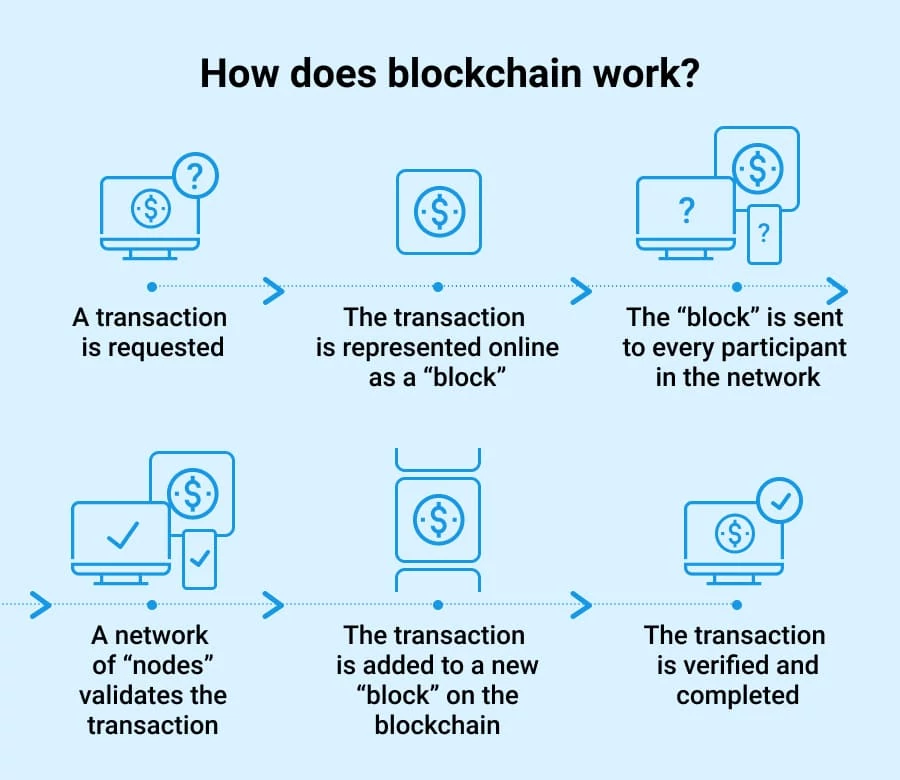
Blockchain is a digital ledger that helps record transactions and track assets in a decentralized network. There is already a myriad of game-changing blockchain use cases across industries. It’s a technology that has started transforming insurance, healthcare, and finance sectors, but this is likely just the beginning.
Bitcoin is the best-known cryptocurrency. It might immediately come to mind when talking about blockchain technologies. However, when we focus on DApps, Ethereum is a term you’ll hear most often. That’s because most decentralized applications are built on this blockchain platform.
Summing up, DApps connect to the blockchain via smart contracts, instead of linking to centralized data servers like traditional apps. A smart contract lies at the core of a DApp as it helps automate agreement execution between parties.
Platforms For DApp Development
As we’ve mentioned above, the majority of DApps are based on the Ethereum platform. With more than 18,000 DApps created across over 90 blockchains and active users approaching 25 million, these applications are becoming the norm.
Ethereum, Solana, Polygon, and Avalanche are among the top DApp development platforms. Ethereum has the most established network and is still leading the pack. Here is a short breakdown of DApp development platforms:
Ethereum: Offers strong security, compatibility, and deep DeFi integration.
Solana: Provides high-speed, low-cost transactions. Ideal for DeFi and gaming
Polygon: It’s an Ethereum scaling solution, offering faster and cheaper transactions
Avalanche: Famous for its near-instant transaction finality
How long does it take to develop a DApp?
In general, developing a DApp may take from 2 to 9 months.
Simple DApps can be implemented within 4 months.
Medium complexity DApps will take around 6 months.
Complex DApps require 6-9 months.
DApp Key Features
Now that you have a general idea about DApps, let’s get more specific and dive into the key features that actually constitute them.
Open Source. A DApp has to be open-source, with no single entity controlling it. It must be autonomous and the code has to be available for inspection.
Decentralized. Its operational records have to be stored on a decentralized blockchain.
Incentivized. It must be able to generate tokens as proof of value and distribute these tokens as rewards on the network.
Protocol-compliant. DApp’s stakeholders must agree on a cryptographic algorithm to show proof of value. For example, both Bitcoin and Ethereum currently use Proof of Work as their consensus protocols. However, the latter is planning to shift to Proof of Stake in the next few years.
To summarize, end users may not even distinguish DApps from traditional applications since the main differences are found in the underlying blockchain protocol.
How is DApp development different from regular app development?
DApp development is totally different from regular app development, specifically in the following factors:
Architecture and servers: DApps use a decentralized peer-to-peer blockchain network to process and store data, while traditional apps rely on centralized servers.
Programming languages: DApps rely on blockchain-specific languages such as Solidity, Move, and Rust to write smart contracts, while regular apps use standard programming languages such as JavaScript, Python, and Swift.
Immutability: Smart contracts are pretty immutable, which makes bug fixing a real challenge, while traditional app code can simply be updated.
Benefits of Decentralized Applications
There’s a reason DApps are gaining popularity. In fact, there’s more than one. Take a look at the advantages of decentralized applications and decide if they could benefit your company.
Censorship Resistance. No government or entity can block users from operating a DApp. No single individual has enough power to control the network, prevent users from submitting transactions, deploying the applications, or reading data from the blockchain. Basically, if Instagram or Twitter were on Ethereum, nobody could block your post or stop you from tweeting.
Anonymity. The majority of DApps don’t require your real identity. Instead of going through an extensive signup process, you just need to have an Ethereum login and a digital wallet.
Zero Downtime. Thanks to its reliance on a peer-to-peer system, the DApp will continue to function even if parts of the network architecture go down. Once it’s live, it will only collapse if the blockchain platform it’s based on crushes as well.
Data Integrity. Cryptography ensures that the data stored on the blockchain can’t be forged by hackers. Moreover, users can access the public blockchain to verify transactions, thus making data records more reliable.
Built-in Payments. There’s no need to integrate your app with third-party payment providers. This makes for much faster payment processing times.
Downsides of Decentralized Applications
Just about anything has a downside or a limitation to consider. DApps are no exception. So, let’s quickly cover their main shortcomings.
Usability. The user experience of some DApps leaves much to be desired. In truth, it can be difficult to navigate. However, chances are, the more organizations turn to blockchain, the better the usability will become.
Maintenance. Since code and data published on the blockchain are harder to modify, DApps can be difficult to maintain. Once the application is deployed, it’s tough for an Ethereum DApp developer to make updates if old versions contain bugs or security risks.
Network Delays. Sometimes, blockchain networks can become overloaded if one DApp is using too many computational resources. As a result, DApp functioning is hindered, leading to slow speed and delayed payment processing.
How To Start With DApp Development?
The blockchain world is creating a vast amount of new opportunities for businesses. If you’re looking for greater transparency, security, and efficiency, blockchain technologies and DApps will certainly catch your attention.
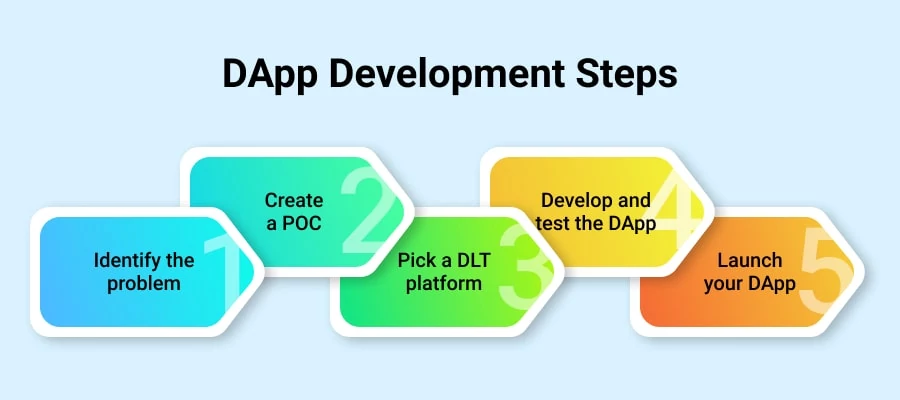
By now, you are probably wondering how to make a DApp and what the development process looks like. Creating decentralized applications is quite different from other custom software development, so let’s take a look at each of the steps below.
1. Identify the Problem
First, it’s imperative to identify the problem you need solving or, in other words, the use case for your future DApp. Start by outlining the difficulties you face and assessing whether a decentralized application can help with them.
Do you want to remove third parties from your transactions? Or, perhaps, you’re looking to distribute information and services away from a central location? Either way, the first step is to figure out what problem a DApp can solve for you.
2. Create a Proof-of-Concept
Next, you need to create a Proof of Concept (POC) to validate your idea and showcase its feasibility. Overall, it will help you test your DApp with minimal resources before committing a large amount of time and money to the development process. Take this step seriously, as it can help you identify pain points and areas of improvement.
If your POC is successful, it’s time to start thinking about execution. Since there are various platforms for DApp development, you need to determine which one will work best for you. Each blockchain platform has its advantages and limitations, hence you need to spend some time figuring out which will suit your requirements.
Currently, Ethereum is likely the most fitting option thanks to its smart contract capabilities. However, make sure to do your own research to select what works for you.
4. Develop and Test the DApp
After picking a DLT platform, you can go ahead and get started with developing and testing your decentralized app. At this stage, having a clear checklist of dApp development services helps align smart contracts, wallet flows, and user experience before launch.Whether you choose to turn to custom application development services or build through an in-house team, make sure the DApp undergoes thorough testing. After all, you don’t want to launch your new software and face issues that could have easily been prevented.
5. Launch your DApp
Finally, after testing, your DApp is ready to launch! Remember to be extra careful when launching on the production server since there is no room for errors. As you recall, it’s hard to make changes once the application is deployed, so don’t rush the process.
These are high-level steps, so as you can imagine, the technical side is a lot more complex. Just keep in mind, you don’t have to go at it alone and figure out how to build a DApp yourself. Instead, consider turning to experienced professionals to get help with your blockchain-based DApp development.
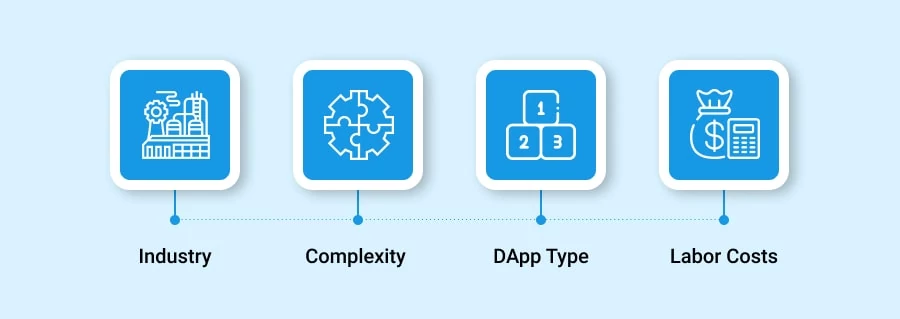
You now know how to build decentralized applications, hence the next natural question is how much this is going to cost you. Unfortunately, there isn’t a simple answer. Rather, a variety of factors affect your DApp development costs, which is why we’ll cover the four main ones below.
Industry
The industry where the DApp will be applied has a major impact on the cost of development. Primarily, it’s because each sector is unique and requires different levels of sophistication. Some industries have strict compliance requirements which need to be catered to. Some may also have a large number of users that will interact with the DApp simultaneously.
In insurance, for example, customers, brokers, and insurers may all need to use one application at the same time. All these differences affect the eventual cost of development.
Complexity
All projects vary in complexity, hence it’s one of the biggest factors affecting DApp building costs. Which blockchain platform are you choosing? What technology stack will be used? Do you need to create a custom API or will you use a pre-built one? You’ll have to answer these questions in order to determine the level of your project complexity.
To give you an example, a low complexity DApp can be a payment application that’s developed around existing cryptocurrencies. Developing a blockchain platform from scratch, on the other hand, would be highly intricate and a lot more expensive.
DApp Type
DApps can either have their own blockchain, like Bitcoin, or use the blockchain of another DApp, like those on Ethereum. Hence, there are three types of DApps and each may have a somewhat different cost of development.
Type 1 DApp: has its own blockchain
Type 2 DApp: functions on a Type 1 blockchain. Doesn’t have its own
Type 3 DApp: functions on a Type 2 protocol
As an analogy, think of Type 1 being macOS, Type 2 being Keynote which works on macOS, and Type 3 being a template add-on that integrates into Keynote.
How much does it cost to build a DApp?
Building a DApp may cost from $20,000 to $100,000+. It all depends on project scope, industry, DApp type, features, security audit requirements, smart contract complexity, team expertise, and location.
Labor Costs
Finally, the cost of labor makes a huge difference in your DApp development budget. Fees will adjust depending on the team size, its location, and qualifications. Besides wages, don’t forget to take into account HR-related costs like recruiting, insurance, and holidays.
Hiring experts in blockchain can be challenging, so make sure you’ve weighed all the pros and cons of developing in-house vs. outsourcing.
DApp development is still in its early stages. However, we are already seeing DApps being used in financial services, gaming, logistics, and other sectors. It is only a matter of time until they become mainstream as enterprises seek ways to streamline processes and enhance security. Now, it’s important not to fall behind.
If you want to stay on top of digital innovation and begin leveraging blockchain-based technologies — don’t hesitate to reach out. The Velvetech team has wide experience in custom blockchain development and building solutions that solve distinct business challenges.
DApps may be nascent, but getting ahead of your competitors with this new technology can set you up for long-term growth and success. So, don’t postpone looking into what decentralized applications can do for you.
Blockchain solutions are gaining traction in the finance sector, but do you already know all their benefits? Read on and discover the key applications of blockchain in finance!
Last year was the year of blockchain Proof of Concepts by IBMs of the world. As IT giants are coming out with successful PoCs, it’s time to review the main use cases for blockchain solutions.
Discover why everyone is talking about Web 3.0 and how exactly the new Internet era will affect your business. Falling behind on this one is probably not a good idea.
We’ve accumulated solid experience across many industries and business cases and consolidated some of its examples in one place to help you make the right decision.
We offer a variety of engagement models for you to choose the one that can expedite your IT initiative and expand software development capabilities in the most efficient and suitable way for your business.
Being more than a team of IT professionals, we support a flexible and progressive environment to adapt to our clients' needs, earn their trust, and grow expertise.