Technology Race in High-Frequency Trading

High-Performance Computing
Achieve lightning-fast processing speed with FPGA programming services, maximizing overall performance for a wide range of applications.

Ultra-Low Latency Networks
Leverage FPGA development services to construct networks with minimal delays and facilitate real-time data transmission for swift and accurate decision-making.

Hardware Acceleration
Harness advanced techniques to enhance computational efficiency and enable rapid execution of complex calculations for HFT algorithms.
FPGA acceleration enables real-time processing by executing tasks directly in programmable hardware rather than sequential software instructions. In contrast with CPUs and GPUs, FPGAs support true parallel data processing and can be customized to match specific workloads, significantly reducing jitter and response time. They are especially valuable for latency-sensitive applications such as high-frequency trading, real-time analytics, and telecommunications.
Ultra-Low-Latency Tick-to-Trade Acceleration with FPGA Hardware
Let’s discuss your project!
FPGA Development Services for High-Frequency Trading
FPGA Infrastructure and Latency Analysis
By analyzing the IT system currently in place at your company, we identify both software and hardware performance bottlenecks. Our experts then find ways for latency optimization in the problematic areas. Among others, this may include acceleration of algorithms, removal of unnecessary interfaces, and consolidation of platforms.
FPGA-Centric System Architecture Design
The designed by Velvetech FPGA-centric architecture offers outstanding operational efficiency. Based on the chips from the market-leading vendors, it provides higher density, lower power consumption, and faster implementation. By adjusting our innovative architecture, we are able to create a custom FPGA system design and come up with a solution that perfectly meets your specific business needs.
FPGA Algorithm Implementation & Acceleration
Adopting a hybrid approach to latency optimization, we develop solutions that combine the advantages of both the hard CPU cores and programmable logic. The majority of trading algorithms in such platforms run on FPGAs, but under the control of more complex and intelligent algorithms on a host system.
FPGA Modernization & Performance Optimization
We help HFT firms modernize legacy FPGA solutions to keep pace with evolving market data feeds, exchange protocols, and hardware platforms. Our services include migrating designs to newer FPGA families, optimizing HDL code, improving timing closure, reducing jitter, and enhancing scalability. This goes without disrupting live trading operations.
Solution Integration, Testing, and Validation
We provide FPGA system integration services to seamlessly connect your platform with other core components, ensuring high-speed data flow in an error-free manner. To guarantee the superior quality and efficient operation of the solution, we subject it to thorough testing at each stage.
FPGA Deployment, Monitoring & Ongoing Support
We support the deployment of FPGA-based trading systems into live, low-latency environments, including co-located data centers. Our team helps set up monitoring, diagnostics, and performance tracking to ensure stable operation and rapid issue detection. We also work on continuous latency optimization.
First of all, FPGA acceleration will be of the utmost benefit to you if your solution requires ultra-fast data processing, deterministic latency, or real-time response. Also, if you want to build a system with high data volumes, strict timing constraints, or complex algorithm execution, it is your go-to. In other words, an FPGA is a great solution where performance directly impacts business outcomes.
Custom FPGA Solutions to Boost Acceleration
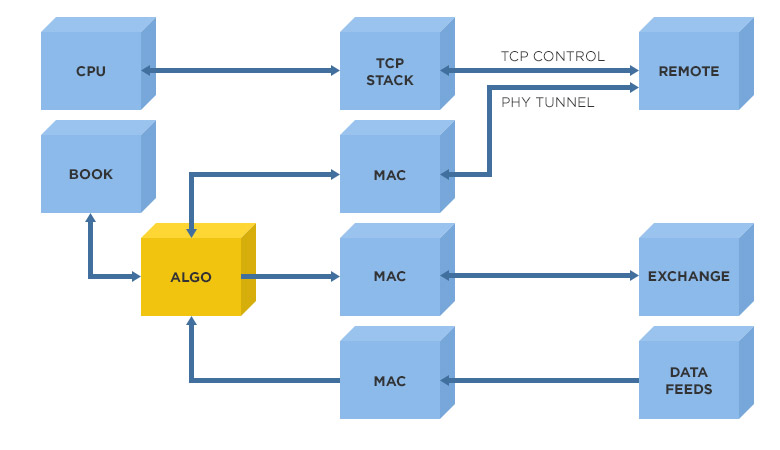
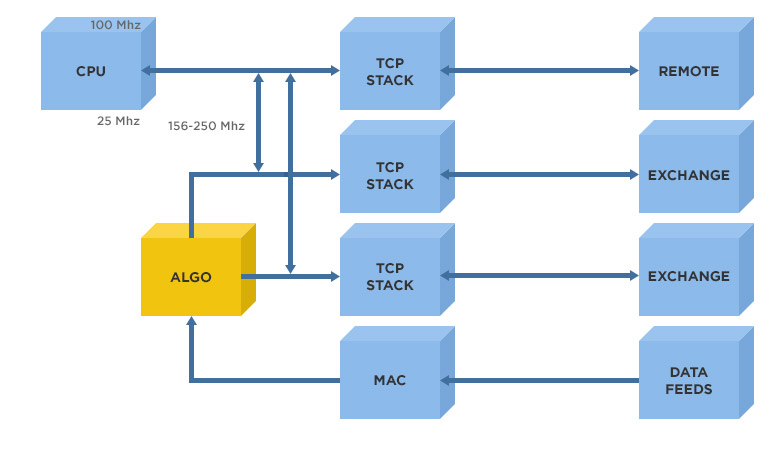
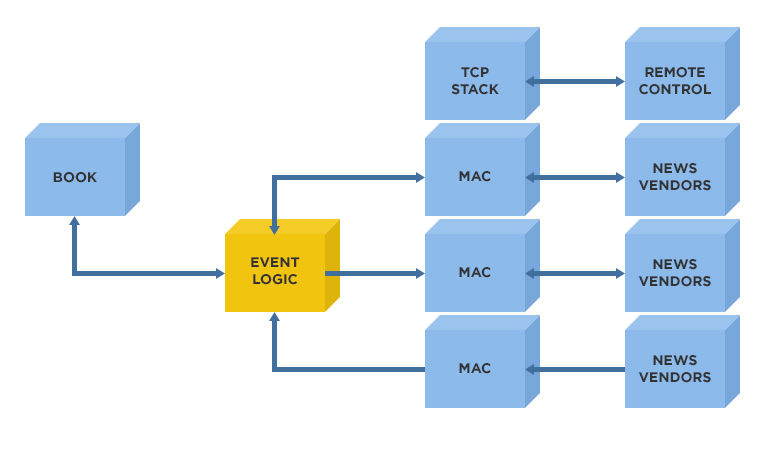
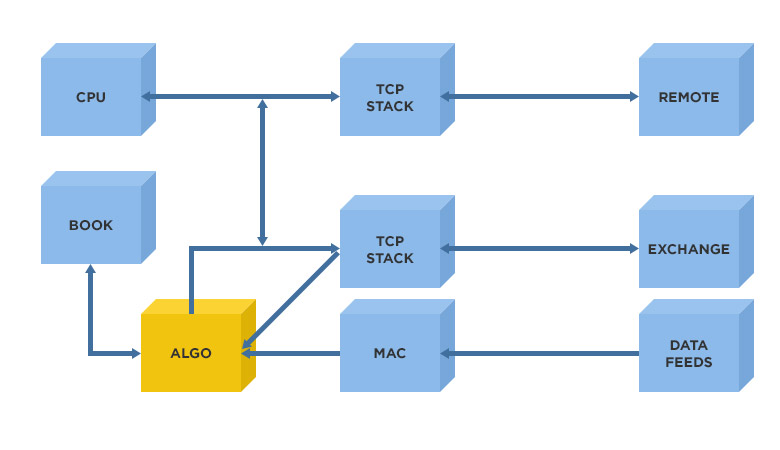

FPGA-Accelerated High-Frequency Trading Platform
Ready to move from idea to a finished solution?
Core Challenges of FPGA Project Implementation

Unique Design
The design of FPGA-accelerated systems is a demanding task that requires considerable experience in both hardware and software development. Only an expert can determine which algorithms would benefit from the hardware implementation and which should be kept in a software shell. When it comes to large designs, there might also be a need to partition them across several FPGA devices.

Low-Level Languages
The programming of FPGA hardware differs considerably from writing software for a generic processor. The functions that take several lines of code in such common programming languages as C or C++ have to be explained in approximately 100 lines when it comes to Verilog and VHDL. Designing logic configurations for an FPGA chip, therefore, is not an easy task and has to be assigned to professionals.

Expensive Team
Engineers who have excellent knowledge of Verilog and VHDL, the core languages used to program FPGAs, are a very scarce resource. Those who have experience in designing platforms for HFT and understand financial market specificities are even harder to find. But even if you manage to do so, the cost of an in-house team of these rare specialists could be a serious burden on your business.

Numerous Vendors
The FPGA-based platforms have already been introduced into various industries. Following the boom in their application, vendors started offering dozens of FPGA chips. Finding the right one for your concrete project is important for achieving the desired results. Considering the substantial price of the hardware, making the wrong choice can also result in significant costs.
Primarily, FPGA is widely used in fintech, including:
- high-frequency trading platforms
- market data processing
- order gateways
- ultra-low-latency networking.
However, FPGA is also applied in AI and machine learning inference, telecommunications infrastructure, video and signal processing, cybersecurity systems, and real-time data analytics. That’s because these areas can benefit from FPGA hardware’s ability to process large data streams in parallel while maintaining predictable and energy-efficient performance.

USA-Based Tech Partner for Your FPGA Acceleration
Velvetech is a software and hardware development company that’s been delivering fintech services and solutions for more than 20 years. The accumulated experience in serving the clients from the trading sector allows our team to decipher the needs of every business and build effective systems that address them to the T.
We bring deep expertise in FPGA hardware engineering, low-latency system design, and hybrid CPU-FPGA architectures required for ultra-high-frequency trading. Our engineers work across HDL development, high-level synthesis, and hardware-software co-design to implement high-performance solutions that meet the strict latency, reliability, and scalability demands of modern trading environments.
Looking for a trusted technology partner?
What Our Clients Say





Technologies We Use
FPGAs
- Altera
- AMD (Xilinx)
Languages
- Verilog
- SystemVerilog
- VHDL
- HLS
- OpenCL
Protocols
- FIX
- CSM
- CMi2
Connectivity
- 10G
- 40G
- 100G