AI is now everywhere and anywhere, and the hype is absolutely clear and truly justified. With this tool, humanity learned to do fantastic things: diagnose diseases at early stages, accelerate scientific discovery, and take real steps to solve the world’s most complex challenges — from climate change to food security.
Putting aside global problems, we shouldn’t forget about more mundane tasks that AI is also able to resolve successfully. Document processing, data entry, customer support, and overall workflow automation: this AI contribution frees up time, reduces errors, and makes daily operations smoother and smarter for businesses of every kind and scale.
However, it’s not all that straightforward. As AI has evolved, it’s branched into several distinct types, each with its own purpose, capabilities, and quirks. From AI agents and conversational models to adaptive and agentic AI, it’s easy to get overwhelmed by the terminology and unsure which type actually fits your workflows best.
In this post, we’ll cut through the noise and help you make sense of it all. You’ll learn what sets these Artificial Intelligence types apart, where they overlap, their limitations, and whether they can be used interchangeably.
Key Highlights
- Different types of AI solve different problems, from customer support to autonomous decision-making.
- Even the smartest AI needs guardrails: whether it’s a human in the loop or an overseeing AI layer that flags risky behavior.
- Control isn’t about micromanagement — it’s about balancing trust, risk, and accountability in the workflows you automate.
- Scaling AI means scaling context, and that’s where most systems struggle without help from humans who still see the full picture.
AI Agents, Conversational, Agentic, and Adaptive AI. Distinctions to Be Explained
AI Agents

Here, let’s consider an example with the financial sector to have a better understanding why it’s not reasonable to compare Agetic AI vs chatbot and equate them . An AI agent might monitor transaction flows in real time, scanning for patterns that signal fraud, money laundering, or other anomalies. Elsewhere, agents act as silent analysts. Imagine a communication platform where users discuss ongoing projects, where an agent could be parsing conversations, surfacing key facts, and automatically feeding those into a knowledge base.
Whether they’re detecting threats, gathering intelligence, or enhancing customer experience, AI agents bring autonomy and insight to business workflows, and their versatility is exactly what makes them so powerful.
The answer depends on the complexity of the task and how much autonomy the system needs. AI agents are best suited for specific, narrowly defined tasks such as transaction monitoring, document classification, or ticket routing. These systems operate well within fixed parameters and deliver reliable results without requiring high-level reasoning.
Agentic AI, on the other hand, is ideal when businesses need systems that can make independent decisions, delegate tasks, and adapt dynamically without constant user input. It’s useful in more complex workflows where goals are broader, context changes frequently, and actions must be coordinated across different sources or agents.
So, the core of the agentic AI vs AI agents difference is in their scope and initiative: AI agents follow instructions; agentic AI figures out what to do next.
Conversational AI

At the moment, AI systems are more multimodal, meaning they accept inputs like text, images, or even video; put simply, the boundaries here are gradually being blurred.
You can now upload an image to GPT, receive a textual interpretation, and continue the conversation naturally. Under the hood, these systems combine multiple models: one to recognize and describe visual data, another to generate text responses. In essence, conversational AI isn’t just about chatting — it’s about enabling intuitive, human-like interaction across different types of input, whether you’re typing, speaking, or even sending visual cues.
Agentic AI

A key distinction of agentic AI vs AI agents is that it involves agents that can collaborate, delegate tasks, search for information, and reason through complex problems without continuous user input. In some cases, these agents even communicate with each other, exchanging data, adjusting strategies, and refining their approach — all in the background, without the direct interference of a user.
A practical example is the research mode in tools like ChatGPT. If we speak about the difference between conversational vs agentic AI, when a user asks a question, the latter may initiate a multi-step process: searching the web, evaluating sources, interpreting the findings, and delivering a synthesized response. What happens under the hood is a chain of decisions and actions taken by one or more intelligent agents working toward a common goal.
The key differences between agentic AI and traditional AI lie in autonomy, initiative, and task complexity.
- Traditional AI (like conversational models) responds to inputs, follows predefined steps, and requires continuous user interaction. It’s reactive — answering questions, processing data, or assisting with tasks only when prompted.
- Agentic AI, on the other hand, acts proactively. It can initiate actions, make decisions, delegate tasks to other agents, and reason through complex problems without constant human input. Think of it as an autonomous teammate rather than a responsive tool.
In short, the differences between agentic AI and traditional AI are about control and capability: agentic systems are more autonomous, goal-driven, and capable of operating independently across multiple steps, while traditional AI executes within narrower, predefined boundaries.
Adaptive AI

Imagine asking an AI to find the cheapest flights to London next month. Instead of following a pre-coded chain of steps, an adaptive AI would dynamically assemble the best set of agents to handle the given request.
One agent might optimize the search parameters, another might surf the internet looking for the best prices, a third could compare dates, and yet another would consolidate and present the results. Importantly, the system decides in real time how to coordinate these agents and distribute responsibilities, without any explicit instructions from the user or developer.
Adaptive AI builds on the foundation of Agentic AI, but it’s more than just an upgrade. While both are capable of making independent decisions and carrying out tasks without constant input, the key distinction lies in how they handle change. Agentic AI can operate autonomously and even coordinate across multiple agents, but its behavior typically follows predefined structures.
Adaptive AI takes this further by continuously reshaping its internal logic, decision paths, or even the agents it uses based on the situation. Instead of relying on a fixed set of rules, it learns and reconfigures itself on the fly, adjusting its behavior to suit changing environments, goals, or data inputs. In this sense, Adaptive AI isn’t just a more powerful version—it’s a more flexible and context-aware evolution that allows systems to stay relevant even as conditions shift.
AI Types Are Different — Application Boundaries Are Similar
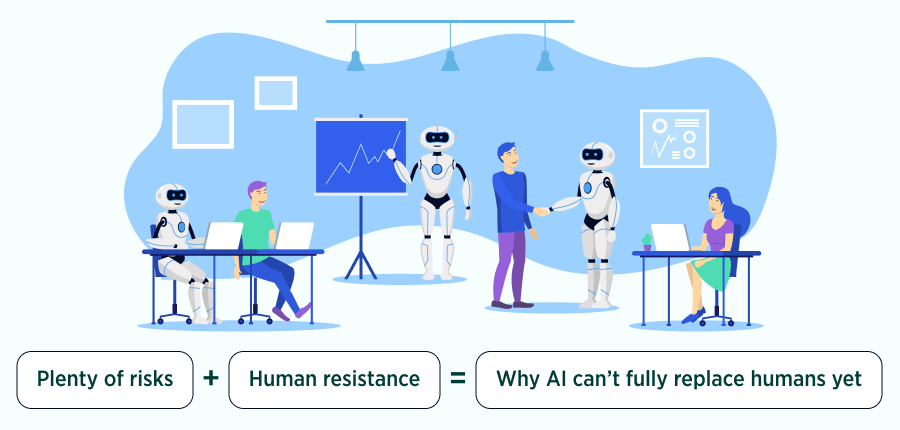
When properly applied, each AI type mentioned above is able to significantly improve the quality of work, cut down the related costs, including labor ones. However, don’t assume that you might thoughtlessly shift all responsibilities to AI, even its most advanced variation, without any negative consequences.
Obviously, in theory, both agentic and adaptive AI are capable of replacing large volumes of manual, repetitive work. Let’s consider a simple example here. Take, for instance, a bank controller who reviews major transactions, checks supporting documents, requests clarifications, and calls clients when something seems off. While this job is important, it’s also highly procedural and increasingly automatable.
However, in high-stakes areas where errors can cost millions, businesses aren’t ready to fully hand over the reins to AI. Legal and reputational risks demand a responsible human in the loop, someone who can be held accountable if things go wrong. If a controller makes a mistake, they can be questioned or even face legal consequences. But with AI, especially black-box systems, assigning responsibility becomes murky.
So while the technology may already be ready, the boundary lies where AI moves from being just a tool to becoming a decision-maker, which might backfire over time.
Explore Generative AI Risks and Regulatory Issues
Human Reluctance to Change as the Biggest Deterrent
One of the most persistent, but least technical, barriers to AI implementation is human resistance. This friction arises not just from fears about job loss, but from a deeper discomfort with shifting power dynamics inside organizations.
It’s rarely as simple as employees being afraid of getting replaced by automation; often, it’s managers who are worried about losing influence, teams sensing their relevance is diminishing, or middle layers of decision-makers unsure how their roles will evolve in an AI-driven environment.
Understandably, people are less motivated to cooperate with systems that may eventually make their roles obsolete. In large companies, especially, this resistance tends to manifest across all levels — from frontline workers to department heads, even up to budget holders who might hesitate to fund initiatives that appear to be sensitive.
Types of Control Even the Most Sophisticated Models Can’t Be Left Without
It’s not a problem to design a fully autonomous, independent system taking care of all your daily tasks; the real complexity lies in making sure the risks they introduce are acceptable and manageable. To address this pressing issue, there are two primary approaches to control.
Human Interference

But when a large enterprise unexpectedly enters the pipeline, say, a billion-dollar company inquiring about franchise insurance, the system can escalate the case. Human agents then step in to manage the interaction, ensuring strategic deals aren’t lost to automation errors or rigid workflows. This approach lets AI handle standard workflows, while routing edge cases or critical events to competent people who can better assess nuances and make informed decisions.
AI as a Controller

If this supervisory AI detects inappropriate language, a policy error, or signs of fraud, it can step in immediately: censor the output, redirect to a human operator, or even block malicious activity altogether. These monitoring layers can be stacked and expanded, offering a scalable way to enforce safety, compliance, and consistency without the necessity to rely entirely on human labor.
The Number of Control Layers to Introduce

If the context is limited, AI tools usually interpret inputs accurately and deliver relevant decisions or responses. But the moment we move into higher-level, strategic domains, the challenge shifts: context balloons in size, and much of it often can’t fit into the processing window of even the most advanced large language models.
Take, for example, managing a franchise location of a global chain like McDonald’s. At a cashier level, tasks are narrow and routine, which is a perfect subject for automation.
But for a manager, decisions span a wide scope: budgeting, staffing, local marketing, vendor coordination, and even external factors like construction or traffic patterns that might affect customer flow. Asking an AI to generate a quarterly budget becomes problematic not because the model can’t compute numbers, but because it may be working from an incomplete or skewed context.
There’s another problem we need to take into account. Not all relevant context is digital or visible. Real-world events like a road closure near the restaurant or a nearby store strike often go unrecorded in any data source the AI can access.
A human manager, commuting to work, sees these disruptions and adapts accordingly, while AI can’t, unless it’s explicitly fed that information. So while we can layer AI control over AI processes, the more abstract and holistic the decision will be, as well as the more fragile and unpredictable AI outcomes become.
GenAI for Business
Using a Unified LLM for Different AI Types Training: Is It Possible?
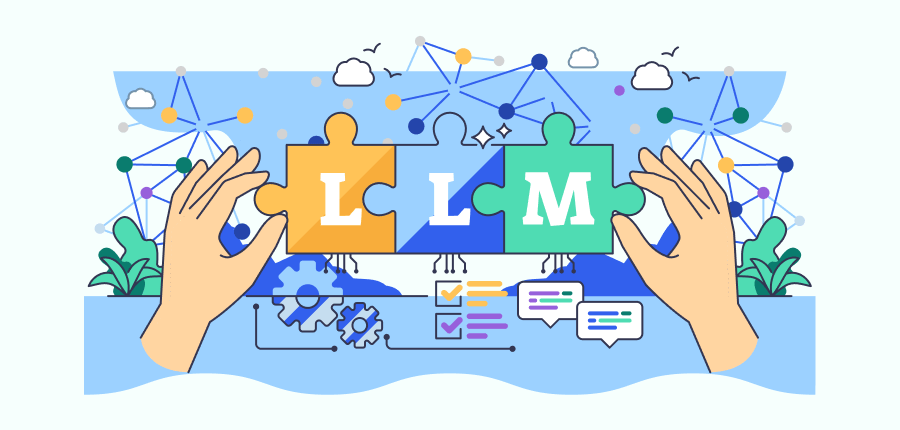
In theory, one LLM can be used for different types of AI systems, be it agentic, adaptive, or conversational AI. But in practice, it’s not that simple.
Different LLMs perform better at different kinds of tasks. Some handle code generation well, others are stronger at writing, reasoning, or data analytics. Because of this, developers often choose specific models for specific tasks. For example, a creative agent might use an OpenAI model, while a finance-focused agent might rely on a model from Anthropic.
Some companies even combine several models in one system. This way, they can get better results and make the system more flexible over time. As older models become outdated and new ones are released, it’s important to be able to switch models without breaking the whole system.
So while using one LLM for everything is possible, using the right tool for each job usually works better and helps the system stay useful in the future.
Learn the Differences Between SLMs and LLMs
Conclusion
AI today isn’t just one thing: there are different types built for different tasks. Some are better at chatting, others at acting on their own, and some can even adapt as they go. Knowing the difference really helps if you want to use AI effectively, not just experiment for the sake of it.
At the same time, it’s not only about technology. People play a huge role in how AI gets used, and sometimes slow things down. Not everyone’s ready to change, and not every task should be handed over to AI completely.
As always, there’s no universal answer or perfect setup. But if you understand what each AI type can do and where it makes sense to apply it, the results can be genuinely useful for people, teams, and businesses.
If you’re planning to bring artificial intelligence into your workflows but aren’t sure where to begin or how to make the most of it, reach out to us, we’ll be happy to help!
About the author