ERP for Logistics: One Brain Coordinating a Thousand Moving Parts

ERP for Logistics: One Brain Coordinating a Thousand Moving Parts

Henry Evans
Henry Evans
Updated on: Sep 28, 2026
•
9 min read

Accuracy and speed are two building blocks of an effective logistics operation. A single delay or incorrect data entry can lead to serious consequences, such as a late shipment, a misplaced item, or a package delivered to the wrong address.

This becomes even more critical for those managing a large-scale logistics business. Imagine the huge workflow, from order placement to final delivery. Ideally, such processes should be automated to minimize manual errors and increase speed.

Besides that, it’s essential to have all your operational data collected in one place, visible within a single environment. That is precisely the opportunities ERP logistics software offers.

Key Highlights

  • Logistics ERP consolidates carrier data into one system and automates shipment updates, leading to smoother transportation and a better customer experience.
  • Integrating IoT sensors with ERP enables real-time monitoring of vehicle and cargo conditions, ensuring safe and timely delivery.
  • AI tools efficiently process the huge volume of ERP data, thus notably elevating the accuracy of data analytics and improving decision-making.
  • On-premises ERP offers full control and ownership, but scaling it alongside growing enterprise needs can be pretty challenging.

Building an effective logistics solution is no walk in the park, and acquiring the right ERP platform is no exception. We’ve put together this publication to explore what ERP systems are capable of delivering for logistics, along with the deployment options and trade-offs to consider before implementing one.

Out of the Silo, Into the System: The Immense Role of ERP for Logistics

Out of the Silo, Into the System: The Immense Role of ERP for Logistics

Large logistics enterprises rely on multiple systems to run. For example, they collect data from warehouses, fleets, carriers, and customer orders. Without clarity across this data, organizing logistics operations would feel like flying blind.

And for many years, businesses had to manually manage these siloed software solutions. Besides being resource-intensive, this approach was also highly prone to errors. But advanced technologies have come to ease much of this burden. A logistics ERP system, specifically, allows unifying these scattered processes into a single, connected environment.

This is just a small portion of what ERP offers. Now, let’s discuss more potential ERP provides for the logistics industry, and explore the core features behind them.

See how we helped the client move From Manual to a Fully Digital ERP Workflow

What is ERP in logistics?

ERP in logistics is a centralized software that brings together critical supply chain operations, from inventory and warehouse management to order processing and transportation. By bringing all of these processes into a single environment, ERP systems ensure real-time data exchange, allowing businesses to spot potential issues early and manage logistics operations more efficiently.

Peeling Back the Layers: Key Features of Logistics ERP

There are different types of ERPs, each coming with its own specific set of features. To choose the right enterprise resource planning solution, you first need to define the main pain points it should address.

Given our expertise in delivering ERP systems for logistics and transportation management, let’s shortlist the core capabilities that we strongly believe lie behind every effective product.

Inventory and Warehouse Management

Inventory and Warehouse Management

This feature is a real treasure trove for logistics companies such as 3PLs and fulfillment providers that need to assist vendors with inventory management, warehouse operations, organizing timely product delivery, and handling reverse logistics.

These companies often manage multiple warehouses across different regions, and they need accurate, up-to-date inventory levels after every shipment and return. This is the only way to establish a balanced stock and identify the nearest warehouse with available goods to organize fast delivery.

Without ERP, logistics providers would need to exchange inventory data from each vendor’s system separately. Accessing required information would be pretty challenging and resource-intensive. Meanwhile, ERP automatically brings all this data into a single environment, allowing companies to simply get the desired information.

Take a look at how we helped a client Speed Up Inventory Tracking

The capabilities of logistics ERP go even further, assisting with warehouse layout planning. Specifically, by collecting data on product turnover, size, and demand patterns, ERP systems provide crucial insights that help optimize overall warehouse space utilization.

Want to manage every part of logistics operations in one place?

LET’S TALK

Shipment Tracking

Shipment Tracking

The next capability of logistics ERP solutions is to present real-time updates on goods’ location. First and foremost, it keeps transportation moving on schedule. Plus, it’s possible to spot issues like congestion and offer alternative routing to avoid delays.

Besides, customers today tend to check shipment updates to see where their goods are at the moment and ensure they’ll receive them on time. To get there, logistics ERP consolidates data from multiple carrier portals into one system and provides automated updates on shipment status. This significantly improves overall transportation efficiency and customer experience.

See how we built a real-time Container Tracking System for a Global Logistics Company

Billing, Invoicing & Compliance Management

Billing, Invoicing & Compliance Management

One of the main pain points of enterprise logistics is dealing with high volumes of financial transactions. ERP billing and payment modules come to automate the entire financial lifecycle, whether it’s invoice creation, multi-channel payments, or even bank reconciliation.

Moreover, for enterprises operating at a global scale, ERP automatically applies the relevant tax rates based on location, product type, or trade agreements. This reduces the risk of compliance violations due to inaccurate rates, missed regional regulations, and other similar errors possible in manual calculations.

Transportation & Fleet Management

Transportation & Fleet Management

How many vehicles does an enterprise fleet typically manage? Often more than hundreds, especially those operating across different regions and countries. Companies at this scale need to accurately coordinate a large fleet, drivers, and delivery schedules to ensure timely and safe shipments.

Without a transportation ERP, enterprises would need to juggle separate systems to collect all relevant data. This is, of course, pretty time-consuming. Not to mention, there’s a high risk of missing some crucial details, such as a missed maintenance alert and delivery downtime, or an inefficient route, which can lead to costly mistakes.

By creating a centralized system that provides a comprehensive overview of all this critical data in one place, ERP notably streamlines fleet management and enhances overall operational efficiency.

Real-Time Analytics & Reporting

Real-Time Analytics & Reporting

It’s clear by now that an ERP system collects big data in one place. This creates the perfect foundation for data analytics. Many modern enterprise resource planning systems allow processing this volume of variables directly through the ERP itself, eliminating the need to utilize separate analytics tools.

ERPs are also capable of updating data in real time and visualizing it through dashboards, thus improving insight accuracy and simplifying report creation.

Off-the-shelf vs. custom logistics ERP: Which is better?

Off-the-shelf products are a good option to solve basic industry tasks, such as standard inventory tracking and order processing. Plus, ready-made solutions are more cost-effective and can be implemented pretty fast.

Custom products, on the other hand, are designed with all the business’s unique requirements in mind. They are the perfect option for large-scale enterprise companies that need a specialized product with advanced features to cover their complex operations. The choice mainly depends on your business size, budget, and operational complexity.

Integrations Getting the Ball Rolling

Integrations Getting the Ball Rolling

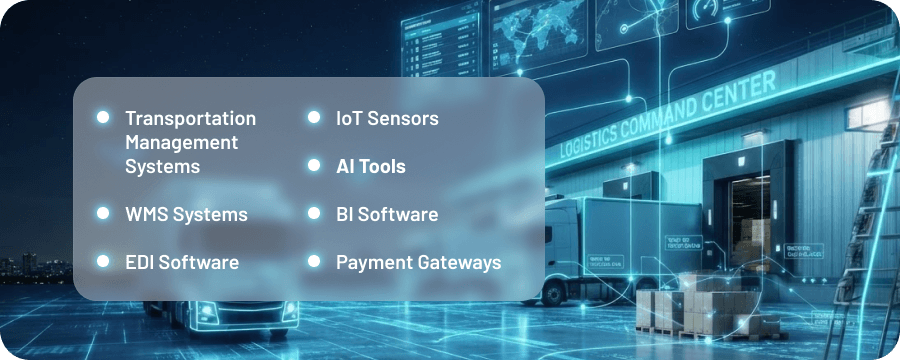
All the capabilities we’ve shortlisted earlier are pretty promising. But to build a truly effective ERP for logistics, your system needs to be connected with the right tools. Here are the top ERP integrations we strongly recommend keeping an eye on.

Transportation Management Systems

First and foremost, it’s crucial to integrate your logistics ERP with TMS systems. This will transfer crucial TMS data, like transit schedules, delivery routes, and freight costs, directly to the ERP. Having all of this information in one centralized system will help you optimize and improve overall freight operations.

WMS Systems

At the heart of every logistics ERP lies its connection to WMS systems. Overall, this integration allows real-time inventory updates, automated pick-list generation, and seamlessly syncs shipping data with the ERP. This ensures balanced stock levels, smoother order processing, and enhanced fulfillment accuracy.

EDI Software

This integration dramatically streamlines document management across the entire supply chain. Specifically, it allows logistics companies to effortlessly connect to partners’ EDI systems and automatically exchange documents like purchase orders, invoices, and shipping information. This elevates the accuracy of shared data and updates transaction statuses in real time.

Need a modern supply chain management solution to solve your business pain points?

REQUEST A QUOTE

IoT Sensors

ERP systems assist in measuring vehicle performance in real time to identify possible issues and minimize breakdowns. But to get there, logistics ERPs should be integrated with IoT sensors, which are responsible for collecting relevant data and sending it to your system.

Data received from IoT devices goes far beyond optimizing routes and ensuring safe deliveries. It also assists in monitoring the condition of transported items, allowing companies to maintain the required temperature and humidity for perishable goods. At the end of the day, minimizing wasted, spoiled products and reducing fuel consumption leads to better sustainability.

Discover how we developed an IoT System for Cold Chain Monitoring

AI Tools

Dealing with the huge datasets collected via IoT sensors and other sources would be nearly impossible without the relevant tools in place. Integrating ERP with AI tools takes the heavy lifting here. Specifically, AI algorithms independently handle huge datasets from ERPs and efficiently process them, assisting enterprises with better decision-making.

Explore more use cases of AI in Logistics

BI Software

Though you may employ AI tools to analyze data, insights may still be hard to interpret. But over recent years, businesses have started interacting with data with far less effort. This change mainly became possible thanks to BI solutions. Integrating them with ERP systems allows you to create easily customized dashboards that visualize insights and simplify analytics.

Exploring Business Intelligence Webinar
ON-DEMAND WEBINAR

BI for Business

Find out the secrets of how business intelligence boosts operations and what BI tools and practices drive data analysis.
Watch Now

Payment Gateways

And the last integration that every ERP system, regardless of industry, should support is payment gateways. This allows you to handle transfers directly within your enterprise resource planning environment.

In particular, integrating a payment gateway with your logistics ERP automates transactions and matches them with specific shipments, notably reducing manual reconciliation and errors.

This integration also allows enterprises to pay carriers, vendors, or drivers through one system, rather than switching between platforms. In addition, this elevates transparency and visibility across both incoming and outgoing transactions.

The Upside and the Catch of the Logistics ERP

While logistics ERP tends to be genuinely useful, building an effective solution isn’t that straightforward. By now, you probably have a solid understanding of the benefits of ERP in logistics.

But since we’re aiming to cover this topic from all sides, let’s also touch on the most common challenges you’ll likely face. Here are the most vivid pros and cons, side by side, for a better comparison.

Advantages
Pitfalls
One unified system: Collect all crucial data in a single place, offering complete visibility across operations
Legacy systems: Old infrastructure may not support integration with new tools, making ERP implementation challenging
Automated workflows: Reduces manual errors and speeds up overall operations
Complexity: ERP systems consider numerous integrations, making the system tough to configure and use
Better customer experience: Provides accurate shipment tracking and calculates the fastest delivery route
High upfront costs: Custom logistics ERP requires licensing, customization, complex feature sets, and implementation, making it pretty costly
Reduced transportation expenses: Optimizes routes, fuel usage, and fleet management to lower overall transportation costs
Lengthy implementation: A custom ERP deployment could take anywhere from several months to a year, delaying ROI

Finding the Right Fit: Where to Host Your Logistics ERP

Finding the Right Fit: Where to Host Your Logistics ERP

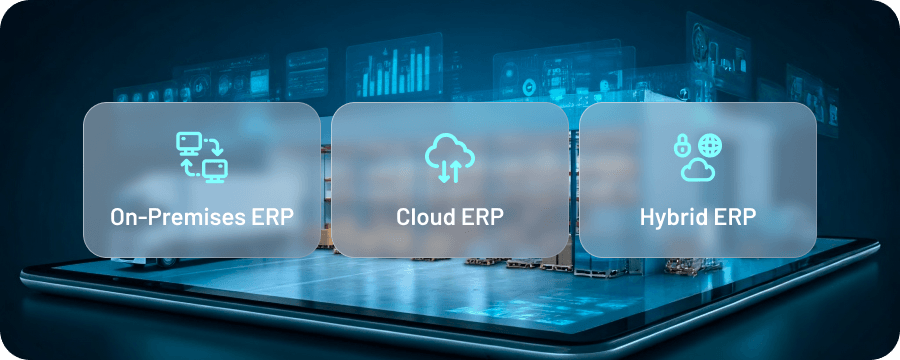
When it comes to ERP adoption, you have several options to consider. The right choice depends on your business needs, of course. The system should be capable of handling all your desired operations. Your budget also plays a crucial role. So let’s see which deployment models are possible:

  • On-Premises ERP: These ERP systems are hosted on the company’s local servers. It means that you have full control and ownership over your system. But one of the main roadblocks of this model is the internal server’s capability, which may often struggle to scale. And given that you need an in-house IT team for maintenance and support, this model won’t come cheap.
  • Cloud ERP: In this case, you rely on cloud platforms rather than local hardware infrastructure, which makes this model more cost-effective and simpler to scale. However, you may need to switch to more advanced subscription options to unlock additional features. Meaning, this model may become expensive over the long run.
  • Hybrid ERP: There may be cases when you need to manage some operations with cloud ERP and others with on-premises. If so, a hybrid model is the best choice. It works well, especially for enterprises that operate in regions or areas with poor internet connectivity, or those that need to keep sensitive data secured on local servers to meet regulations. So, some of the operations may run on-prem, while the rest could be covered through cloud ERP.
How much does a custom logistics ERP cost?

Building a custom logistics ERP may cost from $30,000 to $500,000+. It all depends on the project scope, features, and complexity. An MVP typically costs $30,000–$80,000. A mid-scale platform may require $150,000–$300,000. A complex enterprise logistics ERP may exceed $500,000.

Let’s Get From Talk to Work

With all the bulk of information mentioned above, you can now measure the value of an ERP system for your logistics operations. Yet, neither building a standalone logistics software nor ensuring smooth ERP integration is simple. It requires a strategic approach and strong expertise on both fronts.

At Velvetech, we have helped many logistics enterprises unify their operations and reap all the possible benefits of ERP.

Give us a kickoff call, and let’s see what we can build together.

Contact Our Team

Reach Out to Us

Get a project consultation and estimate — just fill out the form below, and our expert will contact you soon.

What's Next?

1

One of our experts will review your request and reach out to you shortly.

2

If needed, we’ll sign an NDA to ensure your ideas remain confidential.

3

To better understand your goals, we may request additional details.

4

We’ll schedule a call to dive deeper into your vision and share our initial thoughts.

5

If everything feels right, we sign the agreement and kick off your project.