Predictive Analytics in Insurance: An Industry Game-Changer
Data is well on track to become one of the most valuable assets for any organization. It’s precisely what holds all of the key information about your prospects, leads, customers, employees, and the entire business operations.
Yet, besides having data, it’s also extremely important to use it effectively. Today, our focus is on the insurance industry and insurtech solutions that leverage predictive analytics and modeling to make data insightful.
Key Highlights
By analyzing customer behavior and interactions, predictive analytics helps insurers identify customers at risk of churn and provide personalized offers to retain them.
ML models process historical claims data, customer behavior, and payment patterns, allowing insurers to identify suspicious activity early and prevent potential fraud.
Predictive analytics automates claims management and allows insurers to prioritize urgent cases, leading to more accurate and efficient claims processing.
Training predictive models with insufficiently diverse data may lead to algorithmic bias, compromising the fairness of your decisions.
You might already be familiar with data analytics in general, so today we’d like to discuss those that forecast future events. We’ll take a closer look at predictive analytics in insurance and talk about its key uses within the industry so that you can determine whether it’s something your organization should look into.
The Value of Predictive Analytics in Insurance
Predictive analytics is all about forecasting the likelihood of future events. Typically, by going through large amounts of data with the help of artificial intelligence and machine learning algorithms.
In the insurance sector, it can help predict which claims might turn out to be fraudulent or which prospects are likely to carry a higher level of risk.
In truth, insurers have already been using the basics of predictive analysis for years. It’s the cornerstone of every health, life, or auto insurance company. However, the current boost in digital transformation initiatives has made things much more efficient.
Predictive analytics in life insurance, for example, can significantly reduce underwriting expenses. Moreover, data-based forecasts improve sales.
All industry players, from carriers to insurance agencies and brokerage firms, can benefit from effective predictive analytics. So, what are its main uses within the industry? Keep reading to find out.
What is the difference between predictive analytics and predictive modeling?
Predictive analytics is the process of using data and analytical techniques to forecast possible future outcomes and support decision-making. Predictive modeling is one of the techniques used within predictive analytics, where models are built and trained on historical data to identify patterns and forecast future outcomes.
Top Initiatives of Predictive Analytics in Insurance
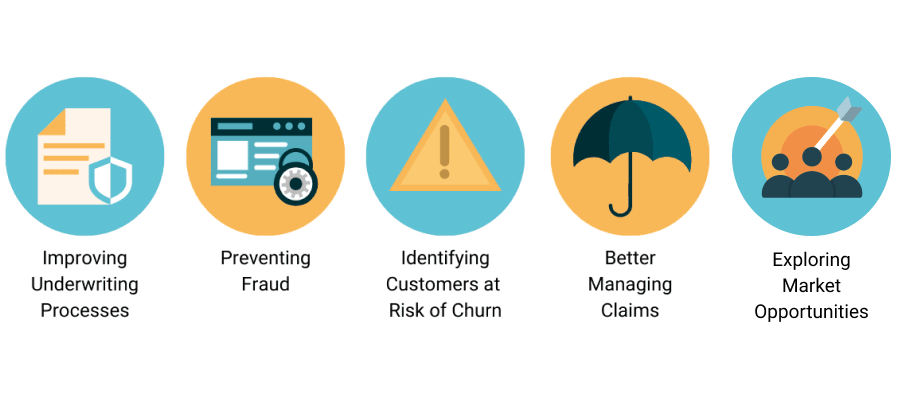
Since predictive analytics tools rely on data and insurtech solutions are filled with lots of it, there are many ways for these technologies to be leveraged within the industry. But let’s shortlist the five most prominent ones.
1. Improving Underwriting Processes
Evaluating risk and determining the right pricing for each client is something insurance companies constantly face. Hence, any tool that helps perform this task more efficiently and with higher accuracy is useful.
In the past, insurance companies would rely on a few variables to determine how to price a policy. Now, with the advancement of predictive analytics, endless amounts of data points can be analyzed. Thus, helping underwriters come up with policies that are catered to each unique customer and maximize potential revenue.
For example, predictive analytics in health insurance can help identify high-risk patients by automatically going through factors that precede chronic illnesses. Specifically, by looking at historical medical data, frequency of gym visits, insights from connected devices, and so on.
Another major goal of employing predictive analytics is identifying customers at risk of canceling their contracts with you.
Insurance companies can monitor customer behavior and gather intelligence during agent-client interactions. For instance, this can be managed with the help of solutions like AI-powered call analytics that alert you whenever someone is unhappy and likely to churn.
That way, insurers get the chance to send special offers to the customers at risk or get in touch to acquire feedback. Thus, alleviating possible concerns and increasing retention rates.
ON-DEMAND WEBINAR
Gaining Control of Customer Engagements
What if every customer could deal with your single most effective sales or service person?
Research shows that insurance fraud in the United States leads to about $308 billion in losses every year. That’s an astounding number that makes insurance companies highly interested in detecting deceptive activities and preventing them in time. With predictive analytics, it has become possible.
Machine learning models learn behavioral patterns from social media and internal platforms, which allows them to identify signs of possible breaches. For example, based on factors such as claim details, customer history, and payment patterns, algorithms can detect suspicious claims, so the insurance companies can prevent potential fraudulent activity early on.
Why does predictive modeling in insurance matter for fraud detection?
Predictive models built on historical claim data, customer behavior, and other relevant factors assist insurance companies in spotting suspicious activity, such as unusual login patterns and unnecessary payouts that can lead to fraudulent activities. This allows insurers to avoid financial losses and sensitive data breaches, which can cause serious compliance fines and damage the company’s reputation.
4. Better Managing Claims
Claims management is one of the most critical processes in insurance. Inefficient decisions can significantly affect both the company’s financial performance and the customer experience. For example, inaccurate claim assessments may lead to overpayments or underpayments; neither is beneficial for insurers. Overpayments can cause financial losses, while underpayments may result in disputes, complaints, and compromise customer trust.
Predictive analytics, on the other hand, can automate this process and help ensure that claims are handled according to their actual value and risk. It can also assist in prioritizing the most urgent claims and identifying those that may not be legitimate.
With less manual effort, insurers can improve accuracy, speed up claims processing, and deliver more efficient services. This also allows employees to stay focused on the most pressing tasks and strategic work.
5. Exploring New Market Opportunities
Finally, let’s see how predictive analysis can be used in insurance to discover new markets and opportunities. Everything is pretty simple — the technology allows for scrutinizing various market indicators like demographics, economic factors, and consumer behavior. This way, identifying potential sectors with unmet insurance needs.
Insurers can leverage analytics to forecast demand, define niche customer segments with unique insurance requirements, and better assess risks in new markets. All this enables businesses to be more agile and responsive to industry trends and customer behavior changes, ensuring they always remain competitive.
Predictive Analytics Use Cases Across Insurance Lines
Insurance isn’t a one-size-fits-all niche. It offers multiple types of coverage, some of which we’ve briefly touched on throughout the article. But let’s take time to discuss how predictive analytics elevates forecasts across different lines of business, helping enterprises accurately assess risk and set reasonable pricing policies.
Life Insurance
Health conditions, lifestyle, age, medical history, previous claims… These are among the critical factors to assess before creating a comprehensive life insurance package. That is to say, insurers need to process large amounts of data and, most importantly, do it accurately. Any missed detail can lead to incorrect risk assessments and inappropriate coverage decisions.
Predictive analytics helps process these variables accurately. This allows insurers to create more suitable coverage based on a policyholder’s risk profile and makes pricing decisions more transparent.
Auto Insurance
When it comes to auto insurance, factors such as the condition and age of the vehicle come to mind first. However, driving behavior and the owner’s previous claims history are of utmost importance. Predictive models process a wide range of relevant data, from accident and claims history to individual driving behavior. Therefore, helping insurers assess risk more accurately and offer the most suitable coverage package.
Let’s say you have two clients who want to insure their properties. One has a house in Oklahoma, where the risk of tornadoes is relatively high, while the other has an apartment in Oregon, where the risk of tornadoes is considerably lower. Obviously, you wouldn’t offer the same coverage package and pricing to both.
Applying predictive models to customer and property profiles allows insurers to estimate the likelihood of potential catastrophes on the basis of historical claims, location, weather patterns, and other relevant risk factors to create appropriate coverage for each asset.
The same applies to liability coverage, which can protect against accidents, injuries, or damage caused to third parties. For example, a house with an indoor fireplace may present a higher risk of accidents than those without one. So, if a visitor is injured in a fireplace-related accident, liability coverage may cover their medical expenses and other related costs.
What Insurance Enterprises Should Consider Before Adopting Predictive Analytics
Though predictive analytics opens up plenty of benefits for insurance businesses, implementing it is not that simple. Based on our experience developing predictive analytics models for businesses across different industries, we recommend keeping an eye on the following factors. We also outline practical ways to assist you in addressing these challenges efficiently.
Pitfall
Solution
Data quality: Incomplete, outdated, or inconsistent data may lead to inaccurate forecasts
Ensure data quality: Clean and standardize data, remove duplicates, correct errors, and regularly update the datasets
Data privacy and security: Handling sensitive customer data makes your system a more attractive target for hackers and increases the risk of cyberattacks
Strengthen security: Use strong security measures such as encryption and access controls, establish proper data governance, and conduct regular security audits
Legacy systems: Older infrastructure may struggle to integrate with modern tools and may not support the technologies required for predictive analytics
Modernize gradually: Use APIs, integration layers, or a data fabric to connect legacy systems with modern analytics tools to ensure smooth infrastructure modernization
Algorithmic bias: If your models are unintentionally trained on biased data, they may provide inaccurate predictions and lead to unfair decisions
Use diverse datasets: Train models on diverse and representative data to reduce bias, regularly test model inputs, and assess their accuracy across different customer groups
High implementation costs: Building and training predictive models won’t come cheap, as they require investment in data infrastructure, skilled professionals, and ongoing maintenance
Start small: Begin with a high-value use case, measure the results, and gradually scale the solution as it delivers measurable value
How much does it cost to build predictive analytics insurance software?
An average cost of building predictive analytics software for the insurance industry may range from $30,000 to $1,000,000. The exact estimate depends on the complexity of the data and models, integrations with existing systems, the number of use cases, infrastructure requirements, and ongoing maintenance.
Getting Started With Predictive Analytics Software Development
From more personalized policy pricing to better claims management processes, technologies that anticipate future events are playing a crucial role in the growth of the insurance industry.
There are many things to consider before committing to building a predictive analytics solution. Not the least of which is choosing an experienced partner that provides professional data science services and can bring your vision to life.
At Velvetech, we have vast expertise in developing custom insurance software that caters to our clients’ needs and helps them get ahead of competitors. So, if your organization is looking to build its own predictive analytics solution — don’t hesitate to reach out. Our team is always happy to help!
Insurance companies are under a lot of pressure to meet the consumer demand for more intuitive, personalized insurance products. Read on to find out how they can meet this challenge.
Discover solutions to insurance brokers’ most common operational challenges and determine whether a ready-made tool or a custom-built platform is right for you.
Every insurance business deals with quote generation, but not all do it efficiently. Read on to discover why insurance quoting software is a must-have for health and life insurers.
Besides AI and IoT, Insurtech revolution is largely driven by the blockchain and smart contracts technologies. Check out the main areas of application for this disruptive tech in insurance.
Investing in digital initiatives is a top priority for many insurance businesses. Find out why agency management software, in particular, is worth looking into.
We’ve accumulated solid experience across many industries and business cases and consolidated some of its examples in one place to help you make the right decision.
We offer a variety of engagement models for you to choose the one that can expedite your IT initiative and expand software development capabilities in the most efficient and suitable way for your business.
Being more than a team of IT professionals, we support a flexible and progressive environment to adapt to our clients' needs, earn their trust, and grow expertise.