Smart manufacturing technologies change how industries operate. These techs, forming the backbone of the ‘smart factory,’ enhance processes through manufacturing automation software, data analysis, and interconnected systems. They enable real-time decision-making, increase efficiency, and reduce waste.
Key Highlights
- AI can optimize workflows, forecast demand, and predict potential breakdowns, thereby significantly contributing to smart manufacturing.
- 3D printing not only speeds up prototype design but also notably simplifies the creation of complex shapes.
- Given the interconnected nature of smart manufacturing, implementing cybersecurity measures has no alternative to keep your systems and operations safe.
- Smart manufacturing employs robots to handle heavy and dangerous tasks, leading to safer workplaces and more productive operations.
Across various sectors, intelligent manufacturing systems have a profound impact. For instance, BMW has successfully adopted AI for hundreds of use cases, from reducing unnecessary repair and waste to autonomous driving.
The cutting-edge smart manufacturing tools are transforming traditional production processes, introducing unprecedented efficiency, productivity, and adaptability. Our article explores the concept of smart manufacturing, its impact on various industries, the core ten technologies, pros and cons, and the future trends shaping this exciting field.
What Is Smart Manufacturing?
Smart manufacturing is an advanced approach to production that takes advantage of technology, data, and industrial automation to positively affect efficiency and flexibility in processes. Central to this concept is the smart factory, an environment where interconnected systems and intelligent machines work seamlessly to optimize production. The components of smart factories represent a significant shift from the old practices to automated manufacturing, emphasizing data-driven decision-making and real-time responses to market demands.
Examples of industries adopting smart manufacturing practices are not limited to automotive and aerospace. Companies within the consumer electronics manufacturing industry, like Samsung, are adopting advanced technologies such as robotics and artificial intelligence to boost production, improve product quality, and drive innovation in the development of next-generation electronic devices.
Find out key AI Types to Stremline Your Business
Construction firms, such as Caterpillar, also lead in advanced technologies. They are incorporating drones, GPS technology, and AI-driven construction equipment for improved project management, safety, and overall efficiency on construction sites.
AI tools process data from different sources, like machines and sensors, in real time, thus notably streamlining predictive maintenance and improving decision-making. Besides merely analyzing data, AI platforms can also offer optimal solutions to handle issues effectively. Eventually, ML algorithms may process historical data and accurately forecast demand, leading to better inventory management.
Levels of a Smart Factory Evolution
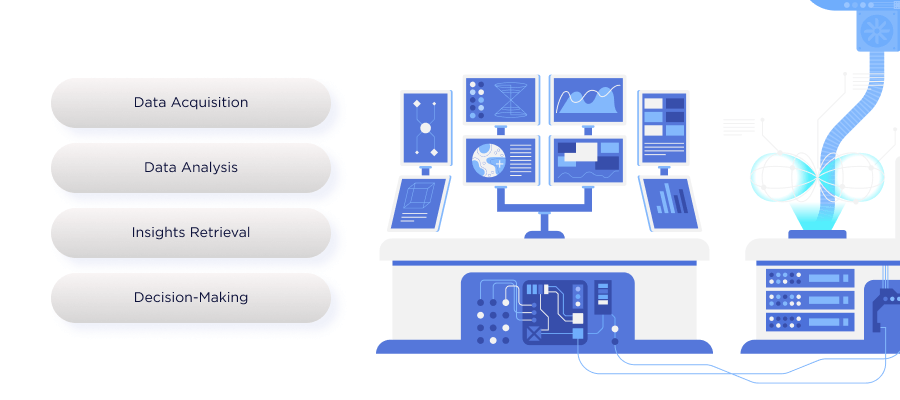
The journey of a smart factory includes a series of progressive stages, each building upon the last to create a fully integrated, intelligent manufacturing environment. This evolution is a technical upgrade and a transformation in how data is utilized to improve business performance. Let’s explore these critical stages in the evolution of a smart factory.
Data Acquisition
The foundation of a smart factory is data acquisition. This stage involves the meticulous collection of data from a myriad of sources: industrial sensors embedded in machinery, production lines, and even environmental monitors. These sensors gather vital information about machine performance, production output, energy consumption, etc. The key to this stage is the breadth and quality of data collected, as it sets the ground for all subsequent analyses and insights.
Data Analysis
With data in hand, the next stage is data analysis. This is where raw data is transformed into meaningful information, often through the use of manufacturing business intelligence solutions. Advanced algorithms and processing tools sift through the vast amounts of data, identifying patterns, anomalies, and trends.
Discover how to Prepare Your Data for Robust Analytics
This stage is critical in understanding the nuances of the manufacturing process, pinpointing areas of inefficiency, and identifying potential improvements. Data analysis turns a sea of information into a focused stream of knowledge.

BI for Business
Insights Retrieval
The true power of a smart factory comes to light in the information retrieval stage. Here, the processed data culminates in precious insights that will provide a strong foundation for future decision-making. They could range from recognizing the need for preventive maintenance to optimize machine uptime to understanding workflow bottlenecks that can be eliminated.
Essentially, this stage is about extracting practical, actionable intelligence from the analyzed data: information that can directly impact the efficiency and effectiveness of the manufacturing process.
Learn more about Preventative Technologies for Supply Chain
Decision-Making
The final stage in the evolution of a smart factory is decision-making. Armed with insights gleaned from thorough data analysis, manufacturers can make informed, strategic decisions. This could involve real-time adjustments to production schedules, long-term investments in new machinery, or changes in supply chain management.
The decision-making stage is where the value of the smart factory is fully visible, as data-driven decisions lead to improved productivity, reduced costs, and enhanced product quality.
If you wonder what technologies help build a smart factory and enjoy better performance, move to the next section and explore what advancements make a difference for manufacturers today.
Essential Technologies in Smart Manufacturing
Smart manufacturing is driven by a suite of advanced technologies. Each technology contributes uniquely, enhancing various aspects of the manufacturing process. Let’s delve into these technologies, their applications, and how they’re reshaping manufacturing.
1. IoT Integration

RFID technology is another important component of IoT integrations in smart manufacturing. In general, RFID tags provide real-time visibility into the supply chain, aiding in better inventory tracking and management. In fact, these tags transform inventory management. At the end of the day, they can be a real helping hand in controlling unauthorized resale.
Read more about Why You Need to Use IoT in Manufacturing Today
The role of IoT is essential in connecting different devices, sensors, and machines with a central network. This allows manufacturing companies to receive critical data (e.g., temperature, pressure, and equipment status) in real time. As a result, manufacturers may promptly identify any potential breakdowns or other issues early on and take proactive steps to mitigate them.
Plus, IoT sensors may highly assist in monitoring production quality by detecting defects early. This not only helps eliminate the need for rework and save budget, but also reduces waste and streamlines sustainability.
2. Data Analytics and AI

The versatile data analytics toolkit now also offers Generative AI, a more creative companion for manufacturers. It greatly optimizes the work of vehicle designers. For example, Toyota uses GenAI to marry design processes and engineering constraints to make inspiration and technical feasibility get along better.
Other data-oriented technologies like computer vision systems are handy, too. They enhance quality control on production lines by visually inspecting products for defects. These systems analyze visual data with precision and accuracy in identifying imperfections. And ultimately, they contribute to improved manufacturing quality and decision-making processes.
GenAI for Business
3. Augmented Reality and Virtual Reality

As for VR simulations, they are not only used to experience a real-life movie. In manufacturing, it simplifies training for workers in complex processes as well as makes it safer. Ford, for example, uses VR to train employees, enhancing safety and proficiency. Besides, VR in smart manufacturing opens more opportunities for remote collaboration among diverse roles within the company.
4. Additive Manufacturing with 3D Printing

Airbus, a leading aerospace company, has embraced 3D printing to fabricate lightweight and intricate components. This innovative approach has not only significantly reduced manufacturing time but has also led to a substantial decrease in material wastage, as evidenced by Airbus’s adoption of this technology.
And, in the healthcare sector, for example, 3D printing has enabled the creation of custom solutions tailored to individual patient needs. Stryker, a prominent medical technology company, has successfully implemented 3D printing to manufacture personalized medical implants. This advancement showcases the potential of additive manufacturing in improving the production of healthcare devices and providing patients with customized and optimized solutions.
5. Advanced Robotics

Generally speaking, robotic technology is already quite diverse and includes different types of robots, such as autonomous mobile robots and AGVs. They streamline material transportation in spacious warehouses and relieve people from excessive movement.
Another type, swarm robotics, is used for large-scale manufacturing tasks. Such robots work in unison for efficiency and precision.
Interested in robotic process automation services?
6. Edge Computing

One prominent player in the field of edge computing for smart manufacturing is Intel. Its solutions have shown significant benefits in optimizing the performance of industrial processes. By deploying edge computing technologies, Intel has effectively reduced latency and improved response times in manufacturing settings. This is crucial for industries where split-second decisions can impact overall productivity, product quality, and worker safety.
Explore How to Tackle Time-Sensitive Issues with IIoT Edge Computing
7. Digital Twins

Take Siemens as an example. It stands among the innovators in the field as a global technology powerhouse. It composed extensive reports on how the technology enabled the company to test and refine products and processes virtually. Thus, leading to fewer prototypes, reduced time to market, and enhanced product quality.
Beyond Siemens, other organizations are also embracing digital twins. For instance, in the energy sector, companies use digital twins to monitor and optimize the performance of wind turbines. This increases increased energy output and reduces maintenance costs. In the automotive industry, digital twins are used to model and improve vehicle design and manufacturing processes to enhance safety and fuel efficiency.
8. 5G

Ericsson’s partnership with Audi exemplifies the potential of 5G in manufacturing. A couple of years ago, together, they explored how 5G can enhance manufacturing applications to increase connectivity and efficiency. 5G’s high-speed data transfer and low latency are crucial for applications such as real-time quality control, remote machine operation, and the integration of augmented reality in production.
5G is also making waves in other sectors. For instance, in many smart factories, 5G enables the deployment of more autonomous mobile robots and drones for material handling and inventory management. In the energy sector, it facilitates real-time monitoring and control of distributed energy resources to enhance grid stability and efficiency.
9. Blockchain in the Supply Chain

Now, let’s think about how manufacturers buy and sell things on the legal side of things. Walmart uses smart contracts based on blockchain to keep agreements up-to-date. These automatically make things happen when certain conditions are met. It helps Walmart manage its processes better, reduces mistakes, and makes communication with partners faster and smoother.
Learn more about How Blockchain-Based Smart Contracts Work Across Industries
10. Computer Numerical Control

Haas Automation, a leading CNC machine tool manufacturer, exemplifies the impact of this technology. They provide solutions that significantly improve machining accuracy and speed. CNC machining enables manufacturers to produce complex parts with high precision, often with tighter tolerances than traditional methods.
Discover the 16 Core Software Types to Apply in Manufacturing
The future of smart manufacturing technology appears promising, and the current advancements signify just the beginning. The continuous integration of technologies into the work environment holds the potential to yield even more significant positive impacts on businesses in the years to come.
Future Trends in Smart Manufacturing
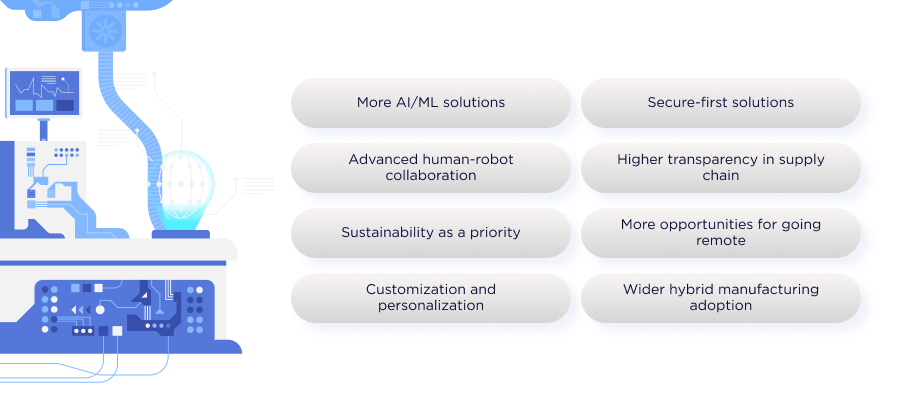
As we stand at the cusp of a new industrial age, the future of smart manufacturing unfolds with a series of trends. These changes are not just technological. Indeed, they herald a new era of efficiency, customization, and sustainability. Let’s explore these compelling trends that are shaping the future of manufacturing.
Human-Robot Collaboration
Industry 5.0 has already made a paradigm shift in human–robot collaboration. Today, collaborative robots, or cobots, are becoming vital in various manufacturing settings, working alongside human counterparts to boost productivity and safety. This collaboration allows for more flexible and efficient production lines, as cobots take on repetitive or hazardous tasks, freeing humans for more complex and creative work. Perhaps the growing synergy between people and technology will continue to create many new opportunities ahead.
Industry 4.0 aims to automate manufacturing processes to increase the efficiency of operations. Overall, it reduces human involvement in manufacturing. Industry 5.0, in comparison, is far more people-centric. While it also incorporates advanced technologies, it aims to strengthen human–robot collaboration instead of solely automating tasks. Its main goal is to assign repetitive and hard tasks to robots, making people stay more focused on creative and strategic work.
Hybrid Manufacturing
Hybrid manufacturing represents the convergence of traditional manufacturing methods with cutting-edge technologies. This approach allows manufacturers to harness the strengths of both worlds: the reliability and familiarity of conventional methods with the precision and flexibility of modern techniques.
In highly conservative industries like the medical field, companies don’t neglect traditional machining and stick to what works best historically. On the other hand, the hybrid approach fosters more healthcare manufacturers to innovate and apply such tech as additive manufacturing to create customized implants and prosthetic devices.
Sustainable Manufacturing
Sustainability is no longer a choice but a necessity and even a legal obligation. The manufacturing sector is increasingly focusing on green practices, emphasizing energy efficiency, resource conservation, and waste reduction. This shift towards sustainable manufacturing is not just environmentally responsible, but it also aligns with consumer preferences and regulatory demands, creating a competitive advantage for businesses.
Read more about How IoT Fosters Industrial Sustainability
Customization and Personalization
The future of manufacturing is increasingly customer-centric, with advances in technology enabling greater customization and personalization. This trend meets the growing demand for tailor-made custom software, from car features to personalized medical devices. Manufacturers who can efficiently cater to these individual preferences will stand out in the market. As part of the trend, manufacturers tend to adopt more mobile solutions with appealing user interfaces.
Cybersecurity in Manufacturing
In an interconnected manufacturing environment, cybersecurity becomes paramount. The integration of IoT devices and cloud computing exposes smart manufacturing systems to new vulnerabilities. Thus, protecting sensitive data and intellectual property is crucial. Robust cybersecurity measures will be integral to safeguarding against cyber threats and ensuring the reliability of manufacturing operations.
Learn more about IoT Security Challenges
Need cybersecurity consulting Services
Supply Chain Innovation
Innovation in supply chain management touches on how products are made and delivered. The blockchain technology and IoT mentioned earlier are creating more transparent, efficient, and resilient supply chains. These technologies enable real-time tracking of materials and products, automate transactions, and enhance supply chain visibility to reduce the risk of disruptions and improve overall efficiency.
Impact on Remote Work
One of the less discussed but significant impacts of smart manufacturing solutions is on the workforce, particularly concerning remote work. Advanced technologies are enabling a more distributed and flexible workforce. Remote monitoring and management of manufacturing processes are becoming feasible, allowing experts to oversee operations from anywhere in the world. This shift expands talent pools, promotes work-life balance, and leads to a more satisfied and productive workforce.
Pros and Cons to Measure Before Turning to Smart Manufacturing
So far, we have focused on explaining smart manufacturing processes, meaning you already have a general understanding of the benefits to expect. However, nothing is purely good. Therefore, before adopting smart manufacturing technologies, it is also important to keep possible pitfalls in mind. This is the only way to be properly prepared for potential challenges.
Hence, before wrapping up, we decided to put together the core pros and cons of intelligent manufacturing systems so you can better assess their impact on your venture.
Benefits |
Challenges |
Task automation minimizes production errors and reduces waste. Plus, it significantly cuts operational costs and elevates overall productivity |
The interconnected nature of smart manufacturing makes it highly vulnerable to security breaches |
Real-time data processing and historical data analytics allow for forecasting equipment failures, thereby minimizing downtime and reducing costly repairs |
Given that smart manufacturing systems collect data from multiple interconnected sources in different formats, managing this data is by no means an easy task |
Robotics has taken over many dangerous and physically demanding tasks, thus significantly reducing the risk of worker injuries |
If you have legacy systems, then integrating advanced technologies into your infrastructure can be quite challenging, oftentimes necessitating |
IoT sensors can monitor the environmental footprint of manufacturing facilities, helping optimize energy consumption and reduce pollution |
In the long run, you will definitely benefit from smart manufacturing systems; however, be prepared to dig deep into your pockets to design them |
Fuel Your Production with Intelligence
Smart manufacturing technologies are not just reshaping how we produce goods; they are redefining the very nature of manufacturing. By embracing these technologies, businesses can unlock new levels of productivity, quality, and innovation. As we look to the future, the integration of manufacturing technologies will continue to drive growth and competitiveness in the manufacturing sector, heralding a new era of industrial excellence.
If staying abreast of the ever-evolving technological landscape is a challenge for you, don’t hesitate to reach out. We are ready to assess your situation and recommend the most suitable technologies tailored to your specific manufacturing process, products, and end-customer experience.
About the author