- Project: Developing an AI credit score analysis platform to help analyze a potential borrower’s credit score
- Technologies: .NET 8, React, Azure (App Service, Functions, Cosmos DB, Service Bus, Blob Storage, Redis)
The Client is a US-based company providing financial services to individuals and lending institutions.
The Client’s Request
The client approached Velvetech with a strategic request: to design and implement a fully automated lending system as a part of a custom automated underwriting app development initiative. The primary objective was to dramatically accelerate the processing time for incoming loan requests, minimize dependency on manual document review, and enable data-driven decision-making for credit approvals.
Prior to engaging with Velvetech, the company had already attempted to tackle this problem by developing an internal solution with the help of a third-party vendor. However, that platform failed to meet even the basic functional expectations. It lacked automation and, most importantly, the ability to analyze and structure haphazard financial documents received from applicants.
Incoming flows, such as bank statements, business profiles, and financial declarations, arrived in non-uniform and inconsistent formats, complicating efforts to extract meaningful data. The existing system relied heavily on traditional OCR tools and static rules, which proved inadequate for parsing complex documents.
As a result, the previous platform simply stored raw documents “as-is” without any real analysis or standardization. This made it impossible to derive structured data from the files or implement a reliable, automated loan decision-making workflow, thereby negating the very purpose of the system.
To replace the outdated solution, the client sought a robust and scalable AI solution for financial risk assessment that could automate underwriting at scale.
Given Velvetech’s proven track record in AI implementation and extensive expertise in building enterprise-grade automation systems, the client selected us as a long-term technology partner to architect and deliver this mission-critical solution.
The Process

Before we got down to the project, we carefully explored the client’s previous solution and analyzed its limitations and bottlenecks to avoid them in the new system. This due diligence allowed us to identify what affected the product’s efficiency and informed our strategic decision not to build upon the legacy system. Instead, we recommended developing a completely new solution from the ground up, and the client agreed with it:
- Scaling the Platform Beyond the MVP
- AI Integration and Decision Tree Implementation
- From a Single Lender to a Multi-Tenant Platform
- Consumer Lending on the Same Engine
- Automating Application Intake Across Multiple Channels
- Third-Party Integrations
- Reducing Manual Underwriting with AI Assistants
- Building a Security Framework for Financial Data
Scaling the Platform Beyond the MVP
The project began with the delivery of an MVP that addressed the core requirements of document ingestion, data structuring, and preliminary loan evaluation logic. At this stage, the focus was on solving the client’s immediate underwriting challenges: turning unstructured application documents into usable data and applying the lender’s rules consistently.
As the solution matured, however, its scope expanded beyond the original MVP. New underwriting scenarios, additional integrations, and new ways of submitting applications were introduced. The custom AI credit scoring software also evolved from a system serving a single lending business into a configurable environment that could support multiple lenders and their partners.
Velvetech took full ownership of the entire product development lifecycle, from defining the system architecture and building out the backend and frontend infrastructure to implementing AI-powered modules as a part of underwriting software development for intelligent document processing and decision-making automation.
The AI lending software development was focused on scalability, and the platform was designed with microservices-based architecture on Azure. This approach allowed new capabilities and business models to be introduced without rebuilding the core system.
Read how we delivered an AI-Powered Assistant for a Global Finance Data Provider
AI Integration and Decision Tree Implementation
The delivered platform is powered by an AI-driven engine that forms an automated underwriting system for the full intake and evaluation of loan application packages. When a new application is submitted, the system receives a complete set of documents, typically in PDF or scanned formats, and initiates a multi-step intelligent processing workflow.
The AI begins by classifying each incoming file and extracting the text layer from each document. It then parses the content to locate and isolate essential data points, such as the company’s official name, incorporation date, owner’s full name, date of birth, and financial figures drawn from statements and tax documents.
This data is then passed through a configurable decision tree — a dynamic rule-based logic engine that determines whether an application meets the criteria for approval. This forms an AI-powered loan approval system that can adapt to each lender’s policy. The decision tree is highly flexible and fully customizable: the client can modify validation rules, add or remove verification steps, and configure different paths depending on the application type.
For example, the system can be set to analyze only the application form, the bank statements, or to include optional checks such as background verification, all based on the lender’s internal policies.
Along with system growth, the decision engine became more sophisticated. It can now evaluate revenue thresholds and revenue trends, apply conditions across multiple steps, exclude specific funding companies from bank statement analysis, define financing tiers, and calculate maximum approval amounts using configurable formulas rather than fixed limits.

The same application can also be evaluated against multiple decision trees. This allows lenders to apply different underwriting policies to the same set of application data without having to process the documents again.
Every step of the decision tree is logged and can be reviewed in detail. Full reports are automatically generated and can be exported in various formats. If the application is approved, the system can also calculate recommended loan terms using an integrated financial calculator. Underwriters can adjust these terms in real time before saving them to the application.
The platform also allows previously processed applications to be re-evaluated against updated decision trees without requiring applicants to submit their documents again. To avoid unnecessary calls to external services, the system uses configurable freshness windows and reuses recent third-party results where appropriate.
Dive into the case study on the Development of an Online Calculator
From a Single Lender to a Multi-Tenant Platform
When it became clear that it’s time to grow further, the client decided to expand it from serving a single lending business to supporting multiple companies within the same environment. Now, each company operates as a separate tenant with its own users, decision trees, settings, and data, while sharing the same underlying underwriting infrastructure.
To support this model, we introduced a credit-based usage system. Each tenant has its own credit balance, while individual decision tree steps can have a configurable credit cost. All transactions are recorded in the usage history, with dashboards providing visibility into credit consumption, processing volumes, and average credits used per decision tree.
The platform also supports brokers as a separate user role. Brokers can be invited to the system, submit applications, and run them against the decision trees available to them, with access to results limited according to their role and activity tracked through the same credit-based model.
Another important step was introducing white-label support for partner lenders. Each partner can use its own branded application forms and connect them to the appropriate tenant. Previously, routing applications between the client’s intake platform and the corresponding lender required hardcoded configuration and development changes. It is now handled through the admin panel, allowing new partners to be onboarded without code changes or deployment.
Consumer Lending on the Same Engine
Initially, it was intended to build a platform for business lending only. However, over time the client decided to extend it and evaluate individual borrowers using the same decision-tree mechanics.
To supplement the system with this functionality, we added AI-powered parsing for paystubs, W-2s, 1099-NECs, and 1040s, with a layout-agnostic approach that handles variations across employers and tax years.
Extracted data feeds an income analysis step that normalizes earnings to annual values, separates bonus income, and cross-checks multiple documents. This allows the system to combine documents such as paystubs with W-2s or 1099-NECs with 1040s into a consistent income picture before applying the lender’s configured conditions.
Speeding Up Application Processing Through Zero Manual Entry Assurance
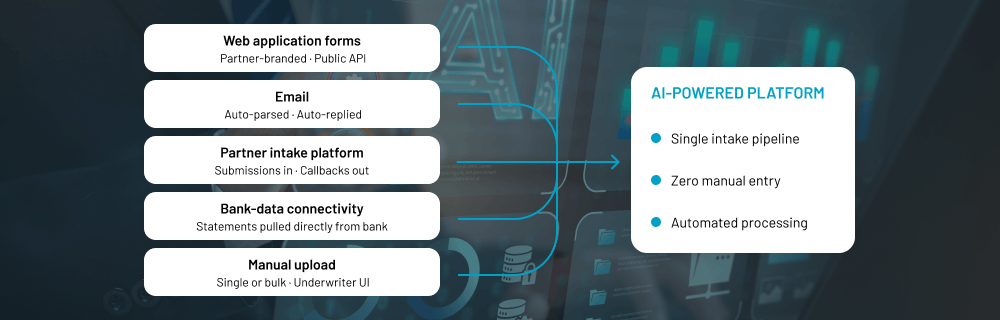
A decision engine is only as fast as the data getting into it. Rather than forcing applicants or partners into a single submission path, the client wanted to have a platform that accepts applications through every channel the client’s business actually relies on, with no manual re-entry at any step.
- Web application forms, including partner-branded ones, submitted through the public API.
- Email, where an incoming message with attachments is parsed, matched to the right company, processed automatically, and answered with an automated reply, with correlation maintained across the whole exchange.
- A partner intake platform, which sends applications in and receives validation and decision callbacks back.
- A bank-data connectivity integration, which retrieves bank statements directly from the applicant’s bank, so nothing has to be attached to the form at all.
- Manual upload in the underwriter interface, single or in bulk.
Third-Party Integrations
The platform integrates with specialized providers covering different parts of the applicant assessment process. Credit and identity verification providers supply structured data for evaluating an applicant’s financial background and trustworthiness, while bank statement analysis and bank-data connectivity providers deliver normalized financial data directly into the decision tree.
The platform also maintains two-way synchronization with the client’s CRM. Incoming applications can create or update contacts, while decision outcomes are written back to the CRM, keeping sales and underwriting teams aligned around the same applicant record.
Reducing Manual Underwriting with AI Assistants
To reduce manual interaction with the underwriting platform and make loan decisioning easier to initiate, we enabled AI assistants to interact with the underwriting workflow directly. The goal was to let underwriters delegate routine steps to an assistant instead of navigating multiple screens and performing each operation manually.
To enable this, we implemented an MCP server that connects the platform with AI assistants such as Claude and Cursor. An assistant can find the available decision trees, create an application, upload documents through a secure link, start validation, track processing, and return the final outcome, including the decision, decline reasons, financing options, and extracted data.
Access is tied to the user’s existing platform credentials, ensuring that the assistant can only perform actions and access data available to that user.
Building a Security Framework for Financial Data
As the platform processes sensitive financial and personal data and is used by external partners, the client needed a clear and reviewable approach to security and compliance. The goal was to document how data, access, integrations, and infrastructure are protected and provide partners with a reliable basis for their own security assessments.
We developed a formal security and compliance profile covering identity and access management, encryption, secrets handling, audit logging, API and input security, third-party risks, infrastructure resilience, and data governance. We also documented data retention requirements and clearly separated controls verified in the source code from those provided by Azure defaults or confirmed by the business.
Result and Future Plans
The platform is now in production and has changed the client’s underwriting workflow from manual document processing to an automated decisioning pipeline. Business and consumer applications can be processed across multiple tenants, while brokers and white-label partners can use the same platform without separate implementations.
Instead of manually reviewing documents and moving data between systems, the client can now automate document intake, data extraction, validation, and decisioning through a single workflow that delivers a decision and priced offer. New lenders and partners can also be onboarded through configuration rather than a new development cycle.
The next stage focuses on extending the platform with an additional risk-scoring assessment tool for applications already approved by the decision tree, providing a second model-driven evaluation before pricing. We also plan to expand the platform across additional business units and partner organizations.