Deeper Insight Into the Role of Cloud Computing Applications in Healthcare
Cloud platforms offer a variety of services to their clients that alleviate system infrastructure maintenance and facilitate data management. But what is the impact of cloud computing on healthcare and which benefits it delivers to medical facilities? Let’s discuss it below.
Budget-Saving for Healthcare Service Providers
No Need to Purchase Costly Hardware
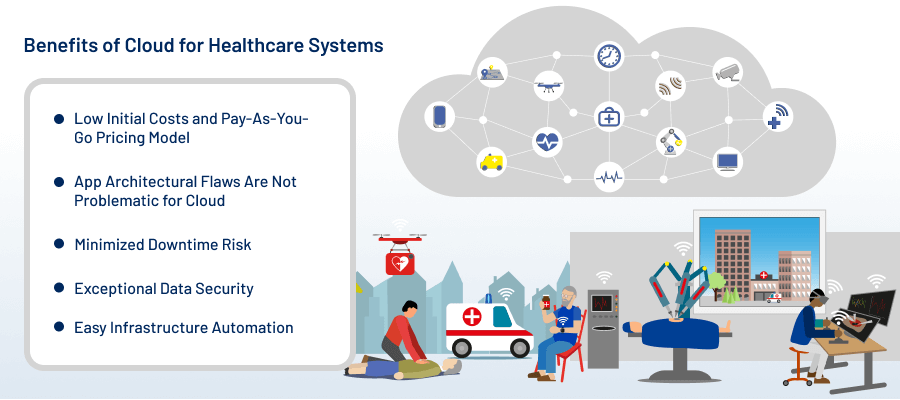
The first and most evident reason for using cloud computing in healthcare is the lower initial cost. If you select on-premises, hardware, peripherals, necessary software, and extra security provisioning effort — all these expenses lie on your shoulders even before you start using the infrastructure and gain value.
Therefore, it’s not just about money, it’s also about the time needed for local data center preparation. This is most noticeable for small and medium-sized medical facilities that have tight budgets but operate large data volumes and need quick access to their IT infrastructure.
Using cloud servers hardware-related hassles are none of your concern; they lie on your provider. Therefore, you may start leveraging your infrastructure right away, without capital investments in its deployment and configurations.
Freedom to Pay As You Go
Let’s consider the following example. You have a chain of clinics scattered across different regions of your country. Each clinic has its unique price list for medical services. And you need to update the prices for all the facilities of the chain.
Taking note of data volume, you may require huge computing capacities to do that. But you need them one time or occasionally, as it’s quite unlikely that you do such recalculations permanently. The cloud definitely wins an on-premises data center since it allows you to pay for the resources you actually consume.
Therefore, you have a chance to significantly save your money on cloud services for healthcare. Say, when you need to process a vast amount of data, you launch the virtual machine at nighttime when the price for cloud computing capacities is lower. Gain the result, record it in the database, and stop using the service.
Cloud providers also offer such a service as Lambda, that alleviates the load on the server and allows you to proceed with calculations faster, despite the amount of requests. These calculations we mentioned above can be done in quite a short time and will not affect other workflows.
The situation is completely different when you use an on-premises data center. In this case, you don’t have an out-of-the-box solution to help you with calculations — you’ll have to do it all with your own effort. As a result, you’ll gain the output in one or two days instead of several hours like in the case with the cloud.
Cloud is More Inclined to Forgive Application Architectural Flaws
Let’s continue discussing the example with price list recalculations from the previous paragraph and why using cloud computing in healthcare is much more reasonable. If, at the design phase, the function of recalculations was not stipulated in your architecture, you may gain additional headaches when using the on-premises infrastructure.
If the application architecture was designed with flaws, some critical points were omitted — most likely, you would have to fix it manually when using an on-premises data center. Architecture review and redesign will take time and additional resources, which is disappointing, but there’s no other way to fix the issue.
The cloud is much more flexible and may forgive some architectural flaws. Why? Because of the wide set of out-of-the-box solutions it offers to users. When your application lacks something, the cloud can cover this need if the feature exists, of course.
Read about the Migration of a Legacy App to the Cloud
Fault-Tolerance and Downtime Risks Minimization
The usage of cloud computing in healthcare significantly mitigates the risks of downtime. Do you remember the story about the fire at one of the European data centers?
If you are a medical facility relying only on one DC, this scenario might resemble a horror movie. You are entirely cut off from your data: your hospital management software, EHR, and billing go dark at once which automatically means that your workflows are frozen and you can’t provide any services to your patients until the consequences are eliminated.
Yes, cataclysms and force majeure happen, or your data center may require electric wiring changes or other maintenance works. If there are several data centers at your disposal, you may easily switch to spare capacities. But if you can’t afford the luxury of maintaining several data centers, it’s better to think thrice before selecting this hosting option.
As a rule, cloud providers offer several rehab zones. This means that when something happens in one DC — they switch you to another smoothly, and you don’t lose control over the infrastructure and mission-critical data.
Exceptional Data Security
Some think that using cloud computing in healthcare is irrational from a security standpoint. Many medical companies prefer keeping their data closer to themselves and erroneously believe it’s the best way to ensure their safety. If you think so, too, let’s consider a vivid example.
You own a medical center, and your infrastructure is deployed at on-premises servers. All the hardware is located and maintained in the same building. Moreover, the clinic’s address is in public access, so a potential intruder already has the information about the location, which is already half the battle.
Have you ever seen the information about cloud providers’ data centers’ exact locations? Very unlikely, and as a rule, they take exceptional security measures, which greatly hampers unauthorized access.
However, physical intrusion is still not everything. How about potential data breaches and unauthorized access to the infrastructure, you may ask? Cloud providers have their answer for this matter.
If you select a reliable cloud platform, 99.9% that it takes robust information security and encryption measures and is compliant with HIPAA requirements. What does this mean?
When you launch the virtual machine to process your sensitive data in the cloud, they are not cached and don’t remain there. All the data you operate with, are guaranteed to be deleted from the server, and nobody, including the cloud provider, can access them.
Discover how to Safeguard Healthcare Data