Growth is supposed to be a good problem to have. Yet many enterprises face a serious challenge at scale. Repetitive tasks like order processing, invoice reconciliation, payroll, and compliance reporting become harder to manage manually.
The risk of errors is too high and may take too long to complete, leading to delays and operational inefficiencies. The most effective way to handle these workflows smoothly is to employ robotic process automation.
Key Highlights
- When combined with AI tools, RPA may process large volumes of unstructured data to better interpret information and act accordingly.
- RPA bots can schedule shipments and assign them to the most optimal carrier, ensuring safe and cost-effective transportation.
- Cloud-based RPA platforms are more cost-effective than on-premise solutions, as they offer pay-as-you-go pricing.
- RPA could be pretty challenging to integrate into legacy systems, as they run on old infrastructure and typically aren’t designed to connect with modern tools.
Today, RPA is actively employed across different industries and is projected to reach $35.8 billion globally by 2033, growing at a CAGR of 29% from 2026. But let’s narrow our focus in this publication and explore the role of RPA in supply chain management and logistics.
Specifically, we will discuss core possibilities, limitations, and the implementation roadmap of this technology worth considering.
RPA vs. AI Automation: Same Ballpark, Different Game
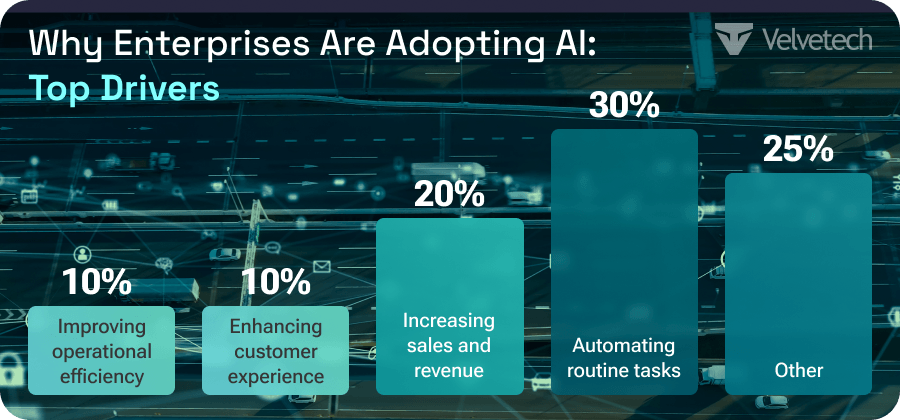
Recently, we organized a poll to assess the core reasons behind AI adoption. 30% of enterprises said they rely on AI to automate repetitive tasks. The truth is, in many cases, it could be simply achieved through RPA.
Let’s get this right: Artificial intelligence, of course, can handle routine task automation, but it wasn’t actually built solely for that. AI algorithms process huge amounts of information in real time, learn from it, and improve over time.
RPA, on the other hand, is built exactly to handle repetitive work, such as picking and packing goods in a warehouse, updating inventory levels, scheduling shipments, and the like. This rule-based nature of RPA makes it more cost-effective compared to AI tools.
Many large-scale enterprises may still consider AI more efficient for complex business process automation than RPA. However, it’s possible to combine RPA bots with AI tools like machine learning and GenAI. This allows bots to better handle large volumes of unstructured data from documents, customer emails, PDF files, images, videos, etc., and interpret information as needed.
That is to say, RPA remains the best choice for repetitive task automation. And you can always enhance bots’ capabilities by pairing them with AI tools.
GenAI for Business
The Growing Importance of RPA in Transportation & Supply Chain

So now you theoretically know in which cases it’s better to give preference to RPA rather than AI automation. Let’s get a tad more specific and explore the core benefits RPA brings to transportation and supply chain.
Safer & Smoother Workflow
Order data entry, shipment tracking, inventory management, invoice processing, and customs documentation are among the core, time-consuming workflows enterprises prefer automating. By elevating the accuracy of these processes, large-scale businesses significantly improve operational efficiency and increase revenue.
Tap into tips on how to create Business Process Automation Strategies
Moreover, in modern warehouses, RPA is actively combined with physical robots to create a safer, more efficient work environment. Particularly, RPA receives data from the WMS about new orders and immediately notifies robots or cobots to handle them. They effortlessly take heavy items from the shelves, transport them within the warehouse, and load goods onto vehicles for shipment. This significantly reduces the possibility of employee injuries.
Explore how we helped the client Elevate Warehouse Operations with BPA
No, RPA is software, while physical robots operate in the real world. They assist with tasks such as picking, packing, and transporting items within warehouses. Being two different technologies, they often work together to automate entire warehouse operations.
24/7 Operations
Let’s say you run a large-scale logistics company that manages multiple warehouses in different regions. Ideally, your WMS system is expected to operate uninterrupted around the clock to process orders, payments, and update shipment statuses.
Instead of managing shift workers to handle all of these tasks manually, you can rely on RPA bots that run on predefined rules. For example, you could create a bot that processes orders independently and provides real-time shipment updates once a consumer makes a purchase.
Smooth Compliance and Documentation
One common pain point across logistics and supply chain businesses is meeting strict industry regulations. Customs documentation, safety standards, trade compliance, financial audits… the list goes on. Handling all of these piles of paperwork manually won’t work. The risk of errors is high and may lead to heavy fines.
RPA addresses this issue as well. Specifically, RPA bots log every operational activity, from data entry and approvals to file transfers and system updates. This creates a clear and timestamped record of business operations, ensuring enterprises are always audit-ready and compliant.
Check out how to Build an Advanced Logistics App
Better Customer Experience
Put yourself in your customer’s shoes. What do you expect after ordering your desired products? Fast and safe shipment probably comes to mind first.
Robotic process automation delivers on two fronts. First, it integrates with warehouse robots, allowing them to start picking, packing the item, and preparing it for transportation right after the purchase is made. This notably speeds up the shipment. RPA also connects with TMS and carrier portals, enabling clients to track delivery in real time.
Need assistance to build a custom logistics management system?
Where the Rubber Meets the Road: RPA Use Cases in Logistics and Supply Chain
Having shortlisted the core benefits of RPA in the transportation and logistics industry, you can assess its true value for your enterprise-scale operations. It is possible to automate plenty of business processes with RPA. But let’s focus on the core use cases that may be the most impactful for your venture.
Order Processing

Each request should be carefully reviewed. Specifically, this means accepting orders, validating customer information, handling payments, and providing updates on shipment status. Managing all of this manually won’t work at scale.
RPA bots instead accurately sort things out. They extract data from different sources and enter it directly into WMS or ERP systems, bringing all records into a single place. This reduces the need to switch between multiple platforms for order management.
Explore how we build a Custom ERP to Align Our Client’s Needs
Shipment Scheduling and Tracking

Check out all the ins and outs of Shipment Tracking Software
AI-powered bots go a step further. They analyze historical shipping data, current traffic patterns, and weather conditions to recommend the most efficient route. Thus, making transportation safe, fast, and cost-effective.
Dive into more interesting use cases of AI in Transportation
Inventory Management

Just picture how many orders your system can handle daily. After each shipment, your inventory needs to be updated to ensure in-demand products are always available. Managing all of this manually eats up valuable time and resources.
RPA bots, instead, handle it effectively. They provide real-time inventory updates and, based on predefined low-stock limits, can automatically reorder goods.
Moreover, AI-powered RPA tools may analyze data on customer behavior, market trends, and historical purchases to forecast possible demand. This ensures your inventory always stays balanced.
See how to excel in Supply Chain Demand Planning and Forecasting
Return Processing

All of these processes are again handled by RPA bots. They validate return requests against company policy, create labels, track the shipment back to the warehouse, process refunds, and update inventory status.
Attended RPA bots collaborate with human employees. For example, they can provide a customer’s full order history to assist a call agent during a support call.
Unattended RPA bots, on the other hand, work autonomously without human intervention. Such bots are typically used for back-office process automation, such as invoice processing, inventory updates, shipment tracking, and the like.
Supplier Management

They assess vendor performance based on predefined factors, such as company profile, background checks, ranking, and the like. This helps you pick a reliable and trustworthy supplier. Besides that, AI-powered bots provide real-time analytics into partners’ performance, allowing you to spot any issues early on.
Find out how to elevate logistics operations with the Freight Broker Software
The Intricacies of Bringing RPA Into Your Operations
It is common for enterprises to dip their toes into emerging technologies. Sure thing, with so many opportunities, you may wish to integrate RPA into your business operations as soon as possible. But the process is far from straightforward. Let’s take a look at the most common challenges many enterprises come across, along with the best possible solutions.
Legacy system integration: Older infrastructure is typically built as a closed system and isn't designed to integrate with modern tools
Modernize your system: You may choose RPA tools with strong API compatibility, or employ a data fabric to bridge old and new systems. But at some point, you may need to modernize your entire IT infrastructure
Scalability issues: On-premise systems often fail to support more RPA bots as automation grows, since scaling requires new hardwares
Leverage cloud-based RPA platforms: They can simply scale up and down, without the need for major infrastructure overhauls
High investments: Costs range from $50,000 for a small-scale deployment up to $500,000 for a full enterprise product
Scale gradually: Choose a pilot project to cut upfront costs, and consider cloud-based platforms, which offer flexible pricing options
Employee resistance to change: Modern tools may not be simple to use. Besides, employees are oftentimes afraid of being replaced by technology
Plan for changes: Offer proper training so employees feel comfortable with new tools, and communicate clearly that technology is there to support them, not to replace
Charting Your Course: An RPA Implementation Roadmap

Implementing RPA requires a strategic approach, which is why business owners prefer to outsource development. A skilled team is expected to have hands-on expertise in working with RPA systems. This provides peace of mind that your project is in good hands.
However, it is still worth knowing some basic steps of useful RPA implementation. This will help you stay on the same page with your team and make confident decisions throughout the process.
- Assess & standardize processes: Before automating, map out your current workflows and identify inconsistencies and bottlenecks. This will help you streamline the productive workflow, ensuring RPA is applied to processes that add real value.
- Identify use cases: Shortlist the core processes that require automation the most. It will help you start small, assess the effectiveness of RPA, make adjustments, and only then move to full-scale automation.
- Integrate with existing systems: To function properly, RPA needs access to relevant data (e.g., order details, inventory levels, shipment records). So, integrate RPA with your existing systems, such as ERP, WMS, and TMS platforms. This will ensure seamless data flow, leading to accurate workflow automation.
- Employ governance and security: Given that RPA bots access both customer and business-sensitive data, it’s crucial to protect this information. So, define clear access-based rules to ensure bots only handle variables they’re allowed to work with. Besides, it’s worth employing security measures and regular compliance checks to avoid possible breaches.
- Manage changes: We’ve already talked about the importance of providing your staff with training to help them get familiar with RPA tools. Ideally, this step should be an inseparable part of your implementation roadmap. Plan it ahead, instead of waiting until your employees get frustrated with new tools. This way, you can keep your team confident and improve RPA tool adoption.
- Monitor and optimize: Once your RPA bots act as intended, it doesn’t mean you should rest on your laurels. RPA requires consistent monitoring to ensure it performs as expected. Regular tracking will help you identify any inaccuracies and optimize the bots to deliver the desired results.
- Scale toward intelligent automation: We’ve highlighted how effective RPA can be when paired with AI tools such as ML and GenAI. So, once your basic RPA proves successful, expand its capabilities. As such, your system goes beyond routine task automation and may assist in decision-making.
RPA is not expected to replace employees in logistics and supply chain. Its main role is to automate repetitive and time-consuming tasks, allowing employees to stay focused on more strategic work.
Ready to Automate? Let’s Do It Right
One thing is pretty clear so far: enterprise logistics and supply chain businesses can’t go far with manual, repetitive workflows. As we’ve seen, RPA is a wise move for automating these kinds of business processes. However, implementing it requires a strategic approach.
If you’re currently looking for an experienced vendor to collaborate with, request a quote. With a knack for building custom RPA systems for different industries, our skilled team will be happy to take on your project.
About the author