Picture a large manufacturing company managing hundreds of suppliers, warehouses, shipments, and customer orders across the globe. As supply chains become increasingly complex, businesses need a way to monitor every stage of their operations, from inventory movement to shipment delivery and customer fulfillment.
What do enterprises need to manage such a complex business environment effectively? The answer is end-to-end supply chain visibility (SCV), which helps assess every aspect of their operations.
Key Highlights
- By providing visibility into stock levels, warehouse space, and product demand, SCV notably improves inventory management.
- A data fabric helps enterprises connect supply chain data from multiple systems into one environment, making visibility easier to manage at scale.
- SCV provides visibility into pollution sources across the network, thus helping enterprises to minimize their carbon footprint.
- Through real-time shipment tracking and equipment monitoring, IoT gives enterprises better control over supply chain visibility.
If you don’t have visibility into your operations, supply chain management becomes like playing chess without seeing the board. Today, we’re going to unpack the nuts and bolts of SCV and see what’s quietly slipping through the cracks without it. Let’s jump right in.
Supply Chain Visibility vs. Transparency: Deciphering the Difference

The difference between supply chain visibility and transparency is a little less obvious. They’re oftentimes taken as the same, but let’s see what distinguishes each.
SCV is a strategy that allows businesses to monitor every component of their supply chains. It provides real-time insights into inventory and warehouse management, shipment status and tracking, production schedules, and similar factors.
This allows enterprises to elevate their operations and spot areas of improvement. Simply put, this is the path leading to intelligent supply chain management.
See how we built Full Visibility for a Transportation Provider with a Data Hub
Supply chain transparency, on the other hand, is the willingness of business owners to share insights on their business operations with third parties, such as global suppliers, stakeholders, and customers.
With that being said, both visibility and transparency are about providing clarity across supply chain operations, just to different audiences. One is for internal teams, the other is for external partners. These concepts are interconnected. After all, a lack of visibility in supply chain operations leaves no room for transparency.
To improve visibility in the supply chain, start by creating a unified environment for all your business data. This will ensure everyone works with the same accurate and up-to-date information. Afterward, employ real-time data tracking to identify any possible threats early on and eliminate critical bottlenecks.
The Levers Delivering Supply Chain Visibility

Getting familiar with the essence of SCV, it is pretty much obvious that large-scale businesses can’t afford to take it as optional. But achieving such a deep operational view is not that straightforward. To build a truly effective supply chain visibility software, it should contain at least these components:
Unified Data Integration
If you run a large-scale business, you probably know the challenge of managing massive datasets. Typically, variables come from CRM systems, warehouse platforms, payment gateways, supplier portals, transportation management systems, ERP tools, and the like.
Ideally, you need one place to consolidate all data, rather than dealing with multiple disconnected systems. And that is exactly what unified data integration offers. It brings all your data sources into a single environment.
But let us be honest, integrating data at an enterprise level is not that simple. Based on our experience working with large-scale supply chain companies, we have found that one of the most common gaps here is the lack of the right architectural decision.
If this sounds familiar, a data fabric approach can help. It ensures seamless integration across multiple systems, creating a single source of truth for supply chain data.
Explore more compelling arguments to employ Data Fabric Architecture
Continuous Monitoring
Another critical component of the SCV worth mentioning is continuous monitoring.
Consider a situation where your supplier’s shipment is delayed. This might lead to production shutdown, inventory shortage, and financial losses. This is where real-time visibility across the supply chain makes all the difference. Once it is clear that a shipment will be late, continuous monitoring gives you the visibility to identify which nearby warehouse has available stock and which alternative supplier can step in, sorting things out with minimal disruption.
Find out how we improved Container Tracking for a Global Logistics Company
End-to-end supply chain visibility covers the entire production lifecycle, from the procurement of raw materials to final delivery and even reverse logistics. This gives businesses a solid overview of their entire network operations.
Analytics & Reporting
Visibility in the supply chain only delivers value when paired with the analytics to interpret it. That is what makes analytics and reporting a core component of the SCV solution, processing large volumes of data accurately and turning raw signals into decisions.
AI tools take this capability even further by automating data analytics and elevating forecast accuracy.
Check out what your Supply Chain Is Missing Without Advanced Data Analytics
All of this may sound quite promising. However, businesses still need support to understand complex datasets and turn them into clear insights. BI tools can serve as a helping hand to this end by representing data through clear dashboards and reports.
BI for Business
The Strategic Payoff of Supply Chain Visibility
With all the bulk of information mentioned above, the critical role of SCV speaks for itself. But let’s move beyond the general statement and look at how supply chain visibility actually improves enterprise operations in practice.
Wise Inventory Planning and Optimization

Dive in to see how to Elevate Stock Planning
This visibility serves as a precious asset for ML algorithms, providing the needed information to improve predictive analytics. By processing historical demand, sales patterns, supplier performance, and other market-related data, ML assists in advanced inventory planning. This provides peace of mind that your shelves are never too full or too empty.
Elevated Operational Efficiency

Find out how we built a Real-Time Cold Chain Monitoring System for Cargo Data
Planning to develop a logistics app and don't know where to start?
Better Risk Management

With SCV in place, businesses can receive timely alerts about such disruptions and respond before they affect production and overall operational performance.
Discover top technologies to Mitigate Supply Chain Risks
Enhanced Customer Satisfaction

By giving clients better visibility into the order fulfillment process and providing real-time shipment tracking, you make the entire delivery experience more trustworthy. After all, reliable delivery builds long-term customer trust, helping businesses retain clients. The backbone enabling this visibility at the order level is typically a dedicated set of order management solutions that consolidate channels, automate routing, and surface real-time status across the fulfillment chain.
Reduced Carbon Footprints

Explore how IIoT assists in Achieving Sustainable Goals
IoT, AI, and cloud computing are among the core technologies that assist in achieving global supply chain visibility. They enable continuous real-time monitoring across the entire network, automate the collection of huge datasets from multiple systems, and elevate data analytics. All of this comes together in one unified environment that connects suppliers, partners, and operations across the globe.
What’s Blocking Your Supply Chain Visibility and How to Clear the Path
The benefits of SCV speak for themselves. It’s a treasure trove for enterprises. Yet maintaining visibility across a large-scale supply chain network is not simple. There are several factors to weigh before you can get there.
Let’s zoom in on the most common supply chain visibility issues, along with the best possible solutions to overcome them.
Advanced Technologies Redefining Supply Chain Visibility
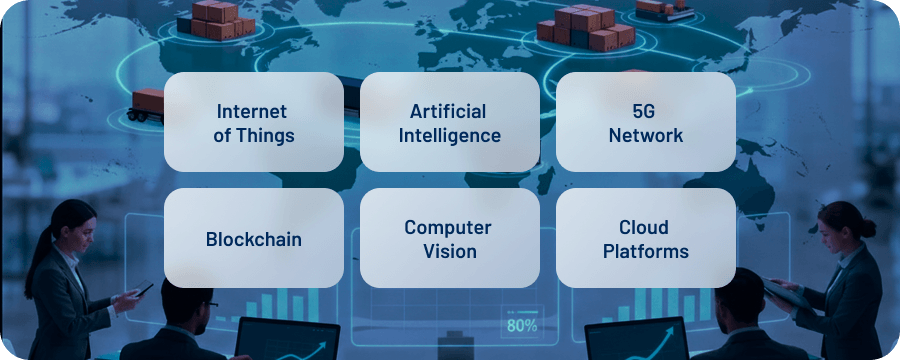
All the benefits we highlighted today would be nearly impossible to achieve without advanced technologies in place. Below, we have shortlisted the core tech trends one should consider to enhance supply chain visibility.
- Internet of things: IoT has become a cornerstone of modern logistics. This technology also plays a major role in ensuring supply chain visibility. IoT assists enterprises in tracking shipments and monitoring equipment conditions, allowing them to respond to issues early on.
- Artificial intelligence: Without AI tools, you simply couldn’t automate supply chain operations, collect real-time data across your entire network, and enhance data analytics. So, it’s definitely one of the must-have technologies today.
- 5G network: To collect data from connected devices, vehicles, and warehouses, you need a reliable and fast data transfer. 5G is the technology that makes this level of real-time connectivity possible. This capability is expected to improve even further with the arrival of 6G, which promises ultra-low latency data exchange.
- Blockchain: If you want to make your supply chain data more transparent and secure, you should definitely keep an eye on blockchain. This technology creates a secure, tamper-proof record of where products come from, where they go, and what happens to them.
- Computer vision: By analyzing video and image data from cameras, scanners, drones, and other visual sources, computer vision gives you a real-time overview of inventory levels, product condition, warehouse activity, and other critical supply chain processes.
- Cloud platforms: We have briefly touched on the importance of these platforms earlier. Besides being cost-effective and scalable, cloud platforms help enterprises connect supply chain data in one place and access real-time updates from anywhere.
Let’s Make Your Supply Chain Data Visible
Without a clear and deep overview of your supply chain network, you simply can’t operate efficiently, identify areas for improvement, and measure critical risks.
That is why supply chain visibility becomes the heart of large-scale businesses. If you are looking for an advanced supply chain solution that can provide end-to-end visibility across your entire operational network, drop us a line. No matter how complex your project is, our experienced team will help you figure it out.
About the author