SaaS Architecture Basics: Benefits and Challenges to Remember
Software as a service (SaaS) adoption has been steadily growing over the last few years with more and more businesses opting for this type of software distribution model. Whether you’re building a SaaS product from scratch or deliberating if an internal SaaS-based solution is better than an on-premise one, the topic of SaaS architecture is bound to come up. In the case of the latter, it can be difficult to decide if, in your unique circumstances, a SaaS architecture is the right fit. In this article, we aim to help.
Key Highlights
Single-tenant SaaS gives in-depth control and customization capabilities, yet it might be way more expensive compared with multi-tenant SaaS.
SaaS application architecture is highly scalable and may effortlessly scale up or down, aligned with your current business needs.
To minimize the risk of data leaks and compliance issues, it’s worthwhile to check whether a SaaS provider has all the necessary certifications or not.
SaaS offers a subscription fee based on usage, making your costs predictable and helping you avoid unexpected expenses.
Our specialists have delivered various SaaS applications in recent years and have extensive knowledge of the key considerations leaders ought to keep in mind when it comes to the architecture of their IT solutions. So, in today’s post, we will dive into the topic in the hopes of helping you determine if SaaS architecture is the right fit for your enterprise.
On the other hand, if you’re more interested in developing a SaaS product from the ground up — take a look at an extensive guide our experts have recently written up. It’ll help you understand the benefits of SaaS product development and what the process might look like.
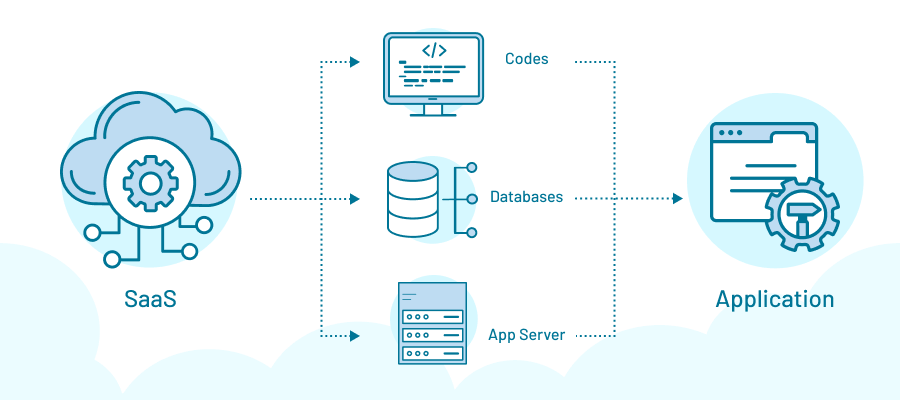
Let’s first talk about definitions. A SaaS architecture simply refers to a method for delivering software to end-users through the Internet. With this approach, businesses don’t need to install and maintain the system on their end, but rather pay a (typically) subscription-based fee to gain access to the application via cloud computing.
In a SaaS architecture, all of the app’s information is hosted on remote servers instead of on-premises of the client. Thus, eliminating the need to handle all of the technical work internally.
The most popular examples of platforms that rely on a SaaS architecture and many businesses employ are CRM systems, design tools, communication apps, accounting software, and the like.
Now, let’s go a little deeper and discuss more specifics. You see, there are two main kinds of SaaS cloud architecture, and they are based on the tenancy model.
In a SaaS system, every customer is considered to be a tenant, and they gain access to the platform by paying a subscription fee. So, there are two options for the architecture in this context — single-tenant and multi-tenant.
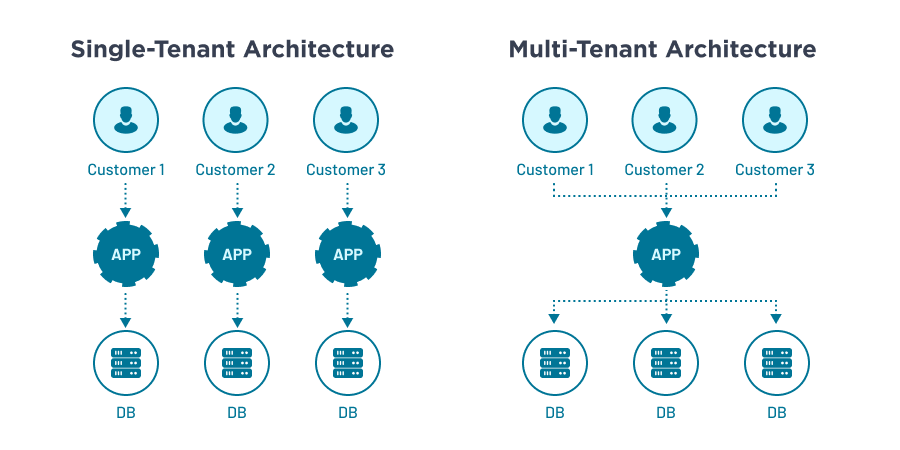
Below, we’ll explain the differences between the two, but first take a look at the SaaS architecture diagram of each as it’ll help you grasp the definitions better.
Single-Tenant Architecture
In this type of a SaaS platform architecture each customer or tenant has their own “instance” of the software, which runs on a separate server and is supported by a single infrastructure and database. Thus, there is no sharing of resources between tenants, and all customer information is separate from other customers.
With this setup comes greater control and customization capabilities, but it might be more expensive for the provider to maintain since they need to manage multiple “instances” of the software.
Multi-Tenant Architecture
On the other hand, multi-tenant architecture refers to a setup where multiple customers or tenants share a single “instance” of the software. This is one of the most popular types of SaaS architecture in cloud computing.
Here, the data of each tenant is kept separate and secure but they share the same app, database, and infrastructure. Unlike the single-tenant version, this setup is more efficient and cost-effective but typically offers less control and customization to individual clients.
In industries like healthcare, where security is of immense importance and HIPAA compliance is non-negotiable, companies may prefer single-tenant architecture. Yet, in the case of consumer-facing apps, multi-tenancy could be a better approach. Choosing between these models is rarely a purely theoretical decision: it depends heavily on the current state of the organization’s infrastructure, integration layers, and governance maturity. An enterprise architecture assessment ahead of an SaaS architecture decision can prevent costly structural misalignments down the line.
What are the common multi-tenancy approaches and their trade-offs?
There are three top multi-tenancy approaches to consider: shared database models, database-per-tenant models, and the hybrid model. Here’s a brief overview of each:
Shared database models are simple and cost-effective, but they are vulnerable to data leakage as all tenants share the same database.
The database-per-tenant model is more secure, as each tenant operates in different databases, preventing them from impacting each other. However, this approach is more complex and expensive.
The hybrid model is pretty flexible, as the tenants choose whether they want to share databases or not. Yet, managing different types of databases and ensuring smooth performance can be challenging.
Benefits of SaaS Architecture
So, why do so many enterprises choose SaaS architecture solutions? Well, there are multiple reasons. Let’s take a closer look at them below.
Speedy Implementation
Enterprise solutions based on a SaaS architecture are easier and faster to implement since they are hosted and maintained by the software provider. Hence, instead of spending ample amounts of time on development, setup, or installation, you simply subscribe to the package that suits your needs best. Then, you’ll swiftly get access to all the necessary features through a web browser, for example.
Predictable Costs
With SaaS, you will likely pay a subscription-based fee depending on usage needs. Naturally, this makes it easier to forecast how much you will be spending each month. Plus, you will avoid large upfront costs and ongoing maintenance fees as the provider takes care of all that and it is usually automatically included in your chosen package.
Scalability
One of the major benefits of SaaS application architecture is that it is created with scalability in mind. This means that as the user, you will be able to seamlessly scale capabilities up or down, depending on the ever changing business needs. For instance, if your organization expands, it will be easy to add more users or features without having to invest in more hardware or software.
Challenges With Opting for SaaS Architecture
Before we get to the best practices of SaaS deployment, let us discuss some challenges you might face along the way. After all, it’s best to be prepared and forewarned than to tackle difficulties suddenly and urgently.
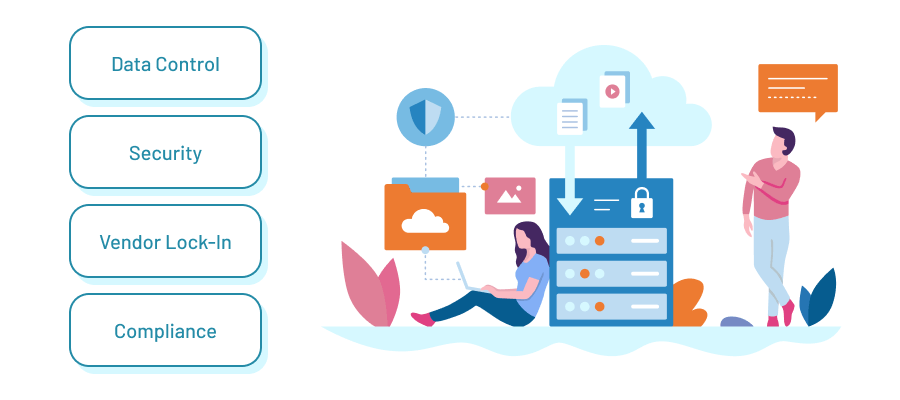
Data Control
When you opt for a SaaS model architecture, you have to realize that there is a certain level of control that you’re giving up. After all, the data is stored on the software provider’s servers, and as a Client, you have to trust that the vendor maintains confidentiality, integrity, and security of the digital information.
Moreover, if after working with one provider you’d like to switch to a different one or bring everything in-house, there might be some difficulties with data portability. So, definitely keep this in mind when making your decision.
Security
Another challenge with SaaS architecture is ensuring security of the digital information. As we said above, the vendor is in charge of maintaining high levels of security and implementing suitable safety measures for the stored data. However, it is your responsibility as a Client to verify that the SaaS provider has all the necessary certifications in place and that partnering with them will not put your data under risk.
Vendor Lock-In
Unsurprisingly, when you pick a SaaS provider, you’ll be tied to the platform they provide, at least for some time. It could be very time-consuming and costly to switch down the road, so definitely don’t rush the evaluation process and select the vendor that best suits your long-term needs.
Regulatory Compliance
Lastly, depending on the industry you operate in, there will be various regulations your business needs to adhere to. Hence, you’ve got to ensure that the selected SaaS provider can demonstrate compliance with the relevant laws and that you aren’t jeopardizing your own reputation or data safety by partnering with them.
How should tenant data be partitioned to balance performance, security, and compliance?
To keep tenant data secure and meet regulations, it’s critical to use separate databases. This way, you can minimize the risk of data leakage. Another wise move to elevate data privacy and compliance is to implement encryption methods and access controls. Overall, it’s preferable to utilize shared databases for non-sensitive data. This way, tenants can gain a cost-effective solution and elevate data security.
SaaS Architecture: Best Practices for Success
Now that we’ve covered all the main things you ought to know prior to getting started with deployment, it’s time to look at the tips that will make the process smoother.
Assess Suitable Plans
First of all, before implementing a SaaS architecture for your next IT project, it’s imperative to assess the different providers that are available on the market and the pricing plans that they offer. Here, you’ll need to consider your budget, the must-have features, and the number of users you’d require. That way, you’ll be able to make an informed decision.
On a similar note, don’t forget to review the Service Level Agreement (SLA) as it typically outlines which services the provider delivers, the required availability and acceptable downtime, and other relevant information.
Customize to Your Needs
Although SaaS tools are largely pre-built and offer off-the-shelf functionality, many still provide customization options, and you should definitely take advantage of this to make the platform fit your unique needs and requirements.
For example, you might want to modify some workflows or simply integrate the solution with other systems that your company already relies on. After all, successful implementation largely depends on how well the new SaaS tool works with your existing tech stack.
Verify How Data Security is Ensured
Like we said, data security is of utmost importance in software that relies on SaaS architecture. So, you’ve got to select a provider that has a good track record of ensuring top levels of information protection. Ask whether or not SaaS providers offer strong encryption, access controls, and regular security audits.
Similarly, don’t forget to review your internal data security processes and whether or not they’ll need to be adapted now that you will rely on a SaaS-based solution.
Depending on your industry, you may be subject to specific compliance regulations like the previously mentioned HIPAA, GDPR, PCI DSS, and others. Naturally, you probably invest a lot of time and money in ensuring you stay compliant.
So, to make things easier, you should partner with SaaS vendors that also comply with any relevant regulations. Otherwise, you will not only risk the company’s financial wellbeing but also might have to face serious legal persecution.
Lastly, once you’ve implemented your SaaS application and the architecture is functioning smoothly, it’s time to monitor performance and the associated costs. Here, you should keep track of end-user satisfaction and ensure that your staff can use the solution seamlessly. By doing so, you’ll be able to assess whether the SaaS model is working well and the architecture remains stable.
Additionally, you should also monitor the SaaS costs to make sure you are not overspending and that your chosen package remains cost-effective over time.
What are secure onboarding and offboarding best practices for tenants?
To ensure smooth tenant management in a SaaS environment, it is critical not only to provide smooth access for new tenants but also to securely remove access for previous tenants.
So, to establish strong onboarding, it’s crucial to implement strong authentication, role-based access control, data encryption, and secure data integrations. Additionally, it’s important to provide tenants with security protocol guidelines.
To succeed in secure offboarding, immediately revoke access to any systems for tenants who are offboarded. Then, delete or transfer their data in accordance with regulatory requirements. Finally, check all API keys and integration tokens to ensure they are invalidated.
Begin Your SaaS Journey With Us
We’ve covered a lot of ground today when it comes to architecture of applications that businesses employ. Now, you hopefully have a better understanding of the benefits, challenges, and best practices enterprises employ when opting for a SaaS architecture. However, we understand that it can be overwhelming to go through all of this research alone.
That’s why Velvetech’s team is happy to offer extensive SaaS application development and customization services to companies from a range of industries. With us, you need not worry about regulatory compliance, data security, and other concerns. We make sure to take all the heavy lifting off of your hands so that you can focus on the bigger picture.
Additionally, we pride ourselves in the ability to build SaaS products from the ground up. Hence, if you’re more interested in this kind of an initiative, we’d love to hear from you. Reach out via the form below and our specialists will get back to you shortly.
Be you a startup or established company, there are rules to the outsourcing of IT projects you should know by heart. Learn how to approach outsourcing software development to avoid pitfalls and gain tangible benefits.
With more and more software solutions on the market every day, it’s imperative to know their most popular types and how you can leverage them. Read on to discover everything there is to know.
Estimating custom software development costs isn’t easy because there are a lot of factors to consider. Discover what they are and how you can get a closer approximation.
Detailed overview of the key mobile development approaches. Learn the pointers for choosing an approach for your app as you read about the basic types, their pros and features.
We’ve accumulated solid experience across many industries and business cases and consolidated some of its examples in one place to help you make the right decision.
We offer a variety of engagement models for you to choose the one that can expedite your IT initiative and expand software development capabilities in the most efficient and suitable way for your business.
Being more than a team of IT professionals, we support a flexible and progressive environment to adapt to our clients' needs, earn their trust, and grow expertise.