Today, more than 400 million terabytes of data are generated globally every day, and this volume continues to grow. For enterprises, these variables are a valuable resource that provides a clear picture of how the business is performing and spots where things could be better.
The thing is, effective data management at this scale is far from straightforward. As an enterprise, you most likely deal with scattered information across multiple systems. Even if you have clear visibility into each system and its data individually, managing them in isolation creates compounding complexity.
An ideal solution is to connect and manage information as a unified whole. Sounds simple enough, but in practice, it could be pretty hard. That’s exactly where data fabric architecture comes in.
Key Highlights
- Data fabric unifies enterprise data from different systems into a single, governed environment, reducing fragmentation and elevating data reliability.
- The Platinum Layer guides AI assistants on how to calculate each metric and what rules to apply, making AI outputs more reliable and trustworthy.
- Many legacy systems aren’t designed to share data, but the data fabric connects them with modern systems without touching the existing infrastructure.
- Data fabric empowers stakeholders to access reliable, self-service data independently, cutting bottlenecks and speeding up decision-making.
The use cases of data fabric go beyond simply connecting data sources. It provides enterprises with a solid foundation for future growth and advanced analytics. What is the true value of this architectural framework, and how do you make the most of it? Let’s break it down.
Why Modern Enterprises Are Increasingly Turning to Data Fabric

Though many tend to associate data fabric with specific industries, it’s tied to the data complexity, rather than to the domain. In general, data fabric architecture is a perfect choice for enterprises that need clarity and control over their variables to ensure reliable metrics and improve data analytics.
Take a large-scale healthcare company, for example. It collects information from systems like EHRs, wearable devices, and well-being apps. Handling all of these data sources separately would be extremely challenging, which is exactly why a data fabric for healthcare has become such a natural fit.
Check out how we helped a healthcare company Streamline Data Storage and Security
Similarly, if you manage an enterprise supply chain and collect information from CRM systems, warehouses, IoT sensors, and the like sources, a data fabric can bring them under one roof. Thus, making data management far less of a headache.
Fragmented supply chain data is slowing you down, and you need a unified ecosystem?
So, what does this unified data ecosystem bring in practice? First and perhaps foremost, it elevates self-service analytics accuracy.
Gone are the days when stakeholders relied solely on their data analysts or BI team to gain insights into critical metrics. Today, many business owners actively utilize self-service tools to work with data independently. It significantly cuts bottlenecks and speeds up decision-making.
However, to receive accurate reports, business owners still require reliable information. And that’s precisely what data fabric offers, providing peace of mind that your data is always clean, governed, and trusted.
A data fabric architecture is a method that unifies data management across separate systems to simplify data access, processing, and governance. It’s especially useful for enterprises that deal with large volumes of data spread across multiple sources.
Where Data Fabric Gets Its Strength: Core Layers Making It Work
Our brief overview of data fabric perhaps gives you a clear picture of the core benefits it brings to enterprises. Now let’s take a look at what this framework actually looks like on the inside, and see which layers it should have to deliver tangible results.
1. Data Ingestion Layer

Take an HR system in a large enterprise, for example. It covers recruitment, payroll, employee performance, and more. And typically, though all of these subdomains fall under HR, there is no single entry point for the data they generate.
The ingestion layer does the heavy lifting here. It connects sources and creates a single data entry point, ensuring complete data visibility across all systems.
2. Storage Layer

Find out the core Differences Between Data Lake and Data Warehouse
It may seem that all you need is to choose the right storage and your data will flow there smoothly. Yet, our years of experience in data engineering show that this layer often becomes pretty chaotic. That is mostly because not every system is capable of delivering clean data. Let alone the fact that many custom-built platforms are oftentimes not set up for variable sharing at all.
In addition, though automation is the talk of the town, not all companies, even those at a large scale, have applied it to their business processes. Some manual workflows still exist, which creates room for mistakes and data inaccuracies.
Explore what you’re leaving on the table without Business Process Automation
3. Data Transformation Layer
It is also crucial to define metrics, business logic, and the relationships between variables, so everyone who works with data operates from the same set of rules. The Semantic Layer is built to provide this accuracy. It brings the entire transformation process together, ensuring your data performs as intended and delivers insights you can actually trust.
See how we built a Unified Data Hub for a Large-Scale Logistics Provider
4. Platinum Intelligence Layer

It’s actually the logical continuation of the Medallion Architecture. However, it’s still an emerging concept and not yet widely adopted. Microsoft is one of the frontrunners in this regard, actively employing a Platinum Layer to prepare semantic models for AI processing. Simply put, it helps AI assistants understand how to calculate each metric and what rules to apply.
As such, AI agents may become more intelligent and could deliver more reliable and trustworthy outputs.
Looking to automate your business workflows? Try an AI-agentic platform.
5. Metadata & Catalog

In addition, metadata and the catalog layer make data ownership transparent. Each model has a responsible person accountable for data quality and changes. This makes the process smoother, so you always know who to address in case of issues.
And finally, this layer labels data based on its sensitivity. Private information, like salaries and personal details, gets flagged accordingly, thus elevating data protection.
This labeling is also crucial for AI agents. There have been many cases where AI unintentionally leaked private information simply because it wasn’t trained to recognize that certain data should be classified. Once marked as sensitive data, it signals AI agents not to share this information without relevant permissions.
6. Monitoring & Notification Layer

But when the system notifies you in real time about a sudden metric drop or anomaly, it’s nearly impossible to miss it. More advanced systems may even suggest how to fix the issue.
What Makes Data Fabric Challenging at Enterprise Scale, and How to Get It Right

Designing an intelligent fabric architecture is by no means an easy task. Depending on your enterprise’s specifics, there may be different challenges to tackle. Based on our experience providing digital transformation across large-scale businesses in different niches, we’ve put together the core pitfalls companies typically face, along with the best possible ways to address them.
Challenge 1: Legacy Systems and Internal Alignment
You’ve built your business over decades, and you likely have plenty of legacy systems in place. It creates a real challenge when it comes to data ingestion: how do you pull data from a platform that was never designed to share it?
Discover how we Modernized a 30-Year Old Plant-Growing System
But the technical side is only half the story. The larger the company, the more stakeholders are involved. Each may have their own priorities and point of view about company changes. This can significantly slow down the decision-making process. Even worse, if something is done incorrectly along the way, the cost of fixing it can be pretty high.
Solution:
If you already know what pain point you want to cover with data fabric, you just need to define clear, measurable goals and set key metrics. This will guide a wise fabric architecture implementation.
If you still don’t have that clarity, start with your system assessment and diagnostics. This way, you can identify what is actually causing the most headaches, and may prioritize what primary issues to solve.
To deal with the data integration issues within closed legacy systems, we advise you to build a license-safe data bridge architecture that can deliver results without modifying the core system.
Data fabric connects to your legacy systems rather than replacing them. It acts like a bridge, providing a unified view of all your data without touching existing infrastructure. Simply put, both your modern and legacy systems work together without any migration required.
Challenge 2: Metric Governance and Semantic Consistency
Another common issue we see in practice is the lack of documentation. Data, reports, and metrics change over time. Yet, layers built on them stay as is. No one owns it, no one maintains it, and it becomes outdated.
On top of that, there is rarely a proper documentation process explaining how each metric is actually calculated. Your existing staff may know it, but people change over time, and new hires end up in a mess, with no understanding of the business logic. Without that clarity, it’s hard to trust the insights delivered by a system.
Solution:
To simplify things, document metric definitions, business rules, and calculation logic. Keep them updated, so everything stays accurate and relevant.
Challenge 3: Data Quality and Trust
To trust your insights, you first need to trust your data. Though it seems quite obvious, this is one of the major issues enterprises face during data fabric implementation. The root cause is almost always the same: data quality wasn’t built into the pipeline from the start.
Instead, thousands of reports and metrics get created, half of which were never properly validated. When built on the fly and never reviewed, the trust would go away at some point either way.
Solution
Prioritize data quality at an early stage of data fabric implementation, not afterward. The sooner you get it right, the less it will cost you.
Plus, fixing data quality issues later is no walk in the park. It’s also worth setting up validation rules, tracking schema changes, and monitoring metric outputs right from the start. This will make the process smoother, more accurate, and budget-friendly.
See how we help our client Automate Data Cleansing
Challenge 4: AI Validation and Reliability
You actively embrace AI to streamline business operations, but hand on heart, do you fully trust its outputs? Hardly. There is always a chance that an AI agent may miss something or misunderstand the input and provide an unreliable answer.
For example, a healthcare provider asks AI, “Which patients are most at risk of readmission?” The AI confidently identifies a group of people, but misses those with chronic conditions who skipped follow-ups, so there is no clarity on their current well-being condition. Yet they remain in the high-risk group. So, while the overall output may be reliable, critical cases could be overlooked.
Solution:
One of the best options to elevate AI agent output accuracy is implementing the Platinum Layer, which we covered earlier.
If your enterprise is decentralized and requires domain-specific teams for data management, data mesh is the wise choice. But if you operate through a highly centralized and governed environment and require heavy data integration, go with a data fabric. The choice simply depends on your enterprise scale, operating model, and integration needs.
Looking Ahead: The Future of Intelligent Data Fabric
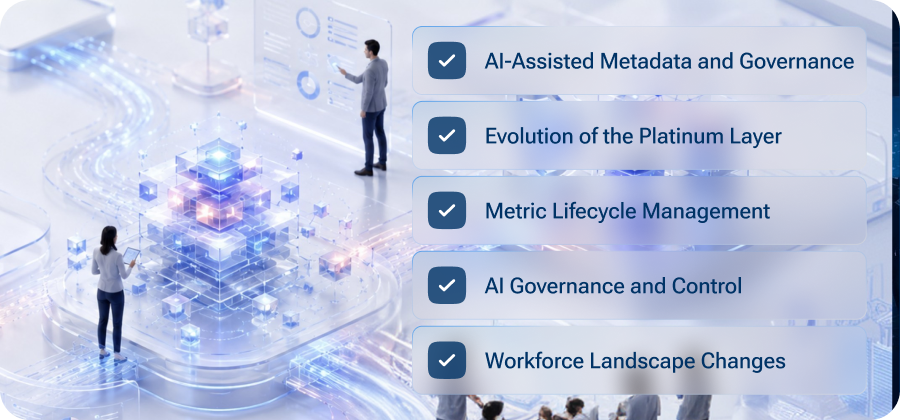
Data fabric is not standing still. AI evolves, enterprise data complexity grows, and the architecture has to keep up. Let’s skim through the most interesting changes lying ahead.
- AI-assisted metadata and governance: Data fabric platforms are becoming smarter. In the near future, they will provide more intelligent assistance and can independently spot undocumented sensitivity labels, missing data quality rules, and other factors that can affect data management. Overall, these platforms are expected to actively analyze all their layers and offer improvement roadmaps.
- Evolution of the Platinum Layer: More and more companies will actively adopt the Platinum Layer to make AI systems understand overall business logic. As such, their inputs will become more trustworthy.
- Metric lifecycle management: The quality of your insights depends entirely on the accuracy of your metrics. So, enterprise systems will start tracking metrics across their full lifecycle to understand how they are calculated, how they evolve, and how they connect to and impact one another.
- AI governance and control: AI is expected to operate under stronger validation, security controls, and governance frameworks. This will lead to unbiased and transparent AI models. It’s, in fact, a future thing, and it’s not yet so clear what tools will govern AI best. But the tendency is there, and the direction is clear.
- Workforce landscape changes: Many companies will likely reduce the number of analysts. Most likely, they will hire staff with different skills, more domain-oriented, and AI tools savvy.
Let’s Build Your Data Fabric the Right Way
By now, it’s probably clear that for enterprises dealing with complex, fragmented data, fabric architecture is bread and butter. Without it, you simply risk losing visibility, trust, and control over your most critical assets.
However, building a solid architecture is not a simple thing. Not to mention, it should be done wisely, preferably after an in-depth enterprise architectural audit. This will showcase where your main problems come from and which pain points you should address first.
Whether you need support with an audit or already know what you should address first, we can assist you in both. Get in touch, and we will build an enterprise data fabric aligned with your unique business needs.
About the author